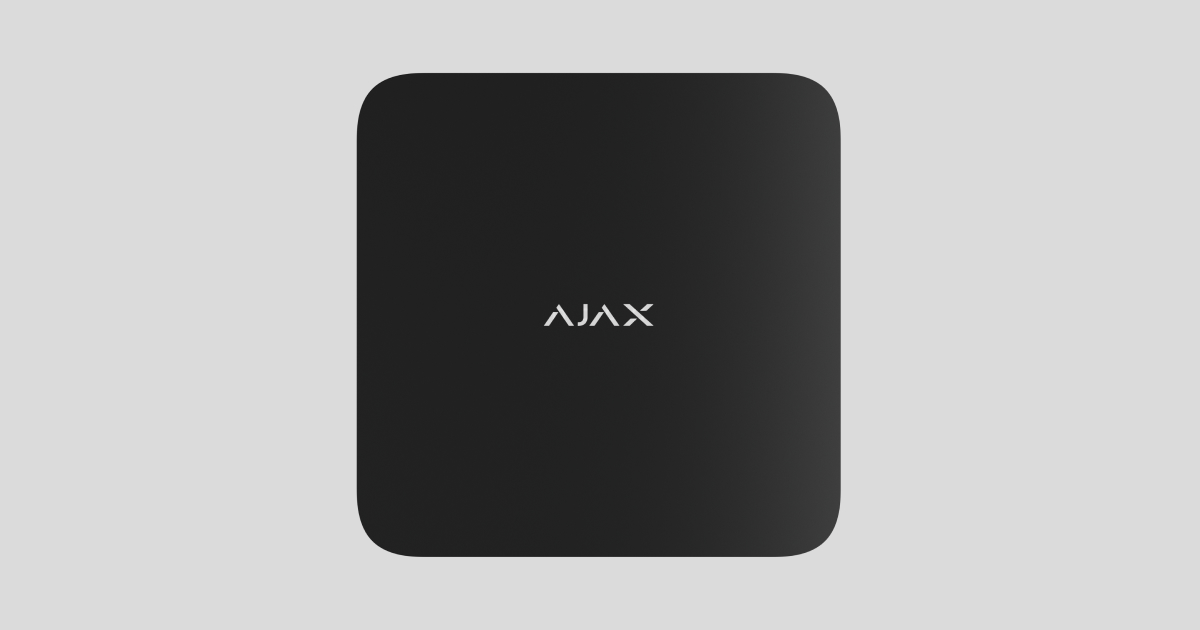
Superior Hub G3 Jeweller is a wireless control panel for an Ajax system with support for photo verification. The hub connects to the Ajax Cloud server via Ethernet, two SIM cards (2G/LTE), and Wi-Fi. The hub has external antenna connectors for сellular, Jeweller, and Wings communication channels.
Superior Hub G3 Jeweller can operate autonomously for 16 or 60 hours, depending on the battery. A backup battery is not included in the complete set. Only compatible batteries can be used: Superior Internal Battery (16h) or Superior Internal Battery (60h).
Superior Hub G3 Jeweller is a device of the Superior product line. Only accredited Ajax Systems partners can sell, install, and maintain Superior products.
Functional elements
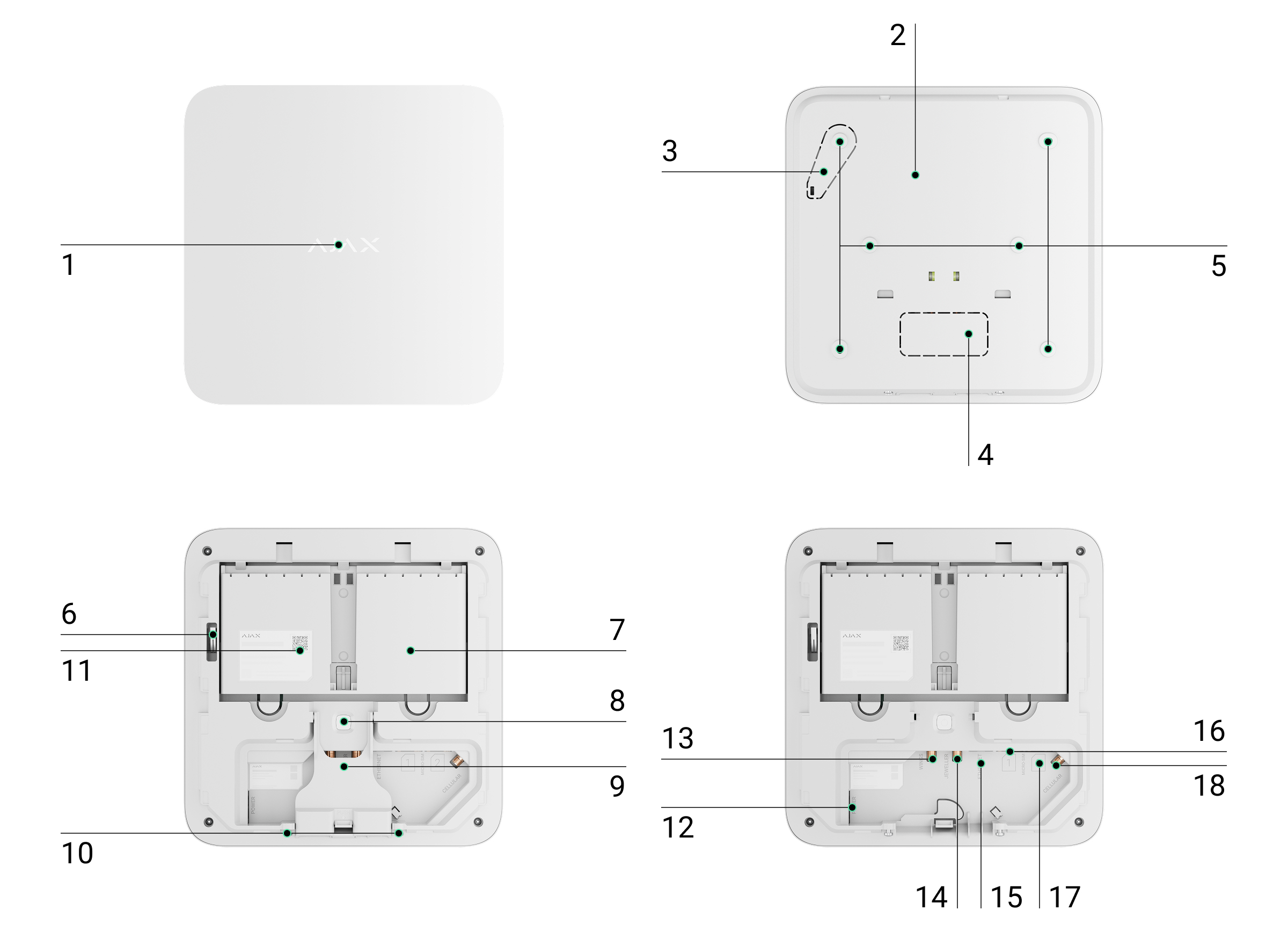
- LED logo indicating the hub state.
- SmartBracket mounting panel.
- Perforated part of the enclosure. It is required for the tamper button to be triggered in case of any attempt to detach the device from the surface. Do not break it off.
- Perforated parts of the enclosure for running power wires and antenna cables.
- Holes for attaching the hub’s SmartBracket to the surface.
- Tamper button.
- Slot for Internal battery (not included).
- Power button.
- Strain relief clip.
- Holding screws for securing the hub to SmartBracket.
- QR code with the device ID. It is used to add the hub to the space.
- Power cable socket.
- External antenna connector for Wings communication channel (SMA female connector).
- External antenna connector for Jeweller communication channel (SMA female connector).
- Ethernet cable socket.
- Slot 1 for micro SIM.
- Slot 2 for micro SIM.
- External antenna connector for cellular communication channel (SMA female connector).
Operating principle
Superior Hub G3 Jeweller is an Ajax system control panel that monitors the operation of added devices.
You can add up to 250 wireless Ajax devices to Superior Hub G3 Jeweller. The added devices protect against intrusion, fire, and flooding, and also allow you to control electrical appliances according to scenarios or manually — in a mobile app or by pressing the panic button, LightSwitch Jeweller, or keypad with a touch screen.
To monitor the operation of all security system devices, the hub communicates with the connected devices using five encrypted protocols:
- Superior Jeweller is an upgraded radio protocol for Superior devices, ensuring compliance with EN 50131 (Grade 3). It features advanced encryption and frequency hopping. Full frequency hopping is available only when all devices in the system use Superior Jeweller. If at least one device operates via the regular Jeweller protocol, the system will be limited to Grade 2: encryption remains, but frequency hopping is disabled.
- Jeweller is a radio protocol for transmitting events and alarms from Ajax wireless devices without Superior Jeweller support.
- TurboWings is a radio protocol for transmitting photos from devices supporting TurboWings.
- Wings is a radio protocol for transmitting large data packets.
- VoRF is a proprietary wireless audio streaming protocol using time division duplex.
The communication range is up to 11,450 ft without obstacles: walls, doors, or inter-floor constructions.
If a device is triggered, the system raises an alarm in less than a second, regardless of the communication protocol. In case of an alarm, the hub activates the sirens, starts the scenarios, and notifies the security company’s monitoring station and all users.
Advanced encrypted communication
The communication between Superior Hub G3 Jeweller and devices is protected by an advanced encryption scheme that ensures data confidentiality and integrity. This means that all sensitive data in the message is encrypted, and each message includes a unique authentication tag allowing the system to verify that the data has not been modified during transmission. The system can reliably detect tampering and reject forged or altered messages, providing robust protection against both passive and active attacks. This ensures secure communication between the device and the hub, as well as reliable system and data protection.
Sabotage protection
Superior Hub G3 Jeweller has four communication channels for connecting to the Ajax Cloud server: Ethernet, Wi-Fi, and two SIM cards. This allows you to connect the device to four different communication providers at the same time. If one of the communication channels is unavailable, the hub will automatically switch to another one and inform the monitoring station of the security company and system users.
When a jamming attempt is detected, the system switches to an idle radio frequency and sends notifications to the monitoring station of the security company and to system users.
The hub regularly checks the quality of communication with all connected devices. If any device loses connection with the control panel, upon expiry of the time specified by the admin, all system users (depending on the settings), as well as the monitoring station of the security company, will receive a notification about the incident.
No one can turn off the hub unnoticed, even when the facility is disarmed. If an intruder tries to open the hub enclosure, the tamper button will trigger immediately. The alarm notification will be sent to the security company and system users.
The hub rechecks Ajax Cloud connection at regular intervals. The ping period is specified in the hub settings. If a minimum ping period is set, the server may notify the users and the security company in as little as 60 seconds after the connection is lost.
Frequency hopping
To comply with the Grade 3 requirements, Superior Hub G3 Jeweller uses frequency hopping for radio communication with the device (or the radio signal range extender). With this method, the hub and devices added to it change their operating frequency according to a defined pattern. The hopping sequence covers a defined set of channels within the operating bands, and devices switch frequencies synchronously with the hub. Even if some channels are affected by jamming, messages can be transmitted successfully via other channels. Frequency hopping improves the system’s reliability and performance and ensures its resistance to intentional interference and jamming attempts.
Frequency hopping does not cause delays or pauses during radio communication and does not reduce the data transfer speed. If range extenders are added to the system, the frequency hopping is used for all radio communications: “device ↔ range extender” and “range extender ↔ hub”.

The system uses frequency hopping for radio communication only if all wireless devices support this method.
If at least one device added to the system does not support frequency hopping, the hub and all devices switch to the operating frequencies of that device and do not use frequency hopping for radio communication.
OS Malevich
Superior Hub G3 Jeweller is run by the real-time operating system OS Malevich. It is protected from viruses and cyber-attacks.
OS Malevich brings new features and functionality to the Ajax security system through over-the-air updates. The update does not require the involvement of an installation engineer or user.
The update takes up to 2 minutes with the security system disarmed and the external power supply and backup battery connected.
Ajax account
To set up the system, install the Ajax PRO app and log in to your PRO account or create a new one if you don’t have one. Don’t create a new account for each space since one account can manage multiple security systems. Where necessary, you can configure separate access rights for each space.
User settings, systems, and parameters of connected devices are stored in the space. Changing the space admin, adding or removing users does not reset the settings of devices added to the space.
Superior Hub G3 Jeweller can only be added and configured in Ajax PRO apps.
Connecting the hub to Ajax Cloud
To be connected to the Ajax Cloud server, Superior Hub G3 Jeweller requires internet access. The connection is needed for the operation of Ajax apps, remote setup and management of the system, and sending push notifications to users.
Superior Hub G3 Jeweller is connected to the internet via the Ethernet communication channel and a cellular network. To increase the system’s reliability and availability, populate both SIM card slots.
To connect to the cellular network, you need to install a micro SIM card with a PIN code request disabled and a sufficient amount of funds on the account to pay for services as per the operator’s tariff. To disable the PIN code request, insert the SIM card into the phone.
As the hub connects to the internet only via the cellular network, it automatically sets the APN settings based on the installed SIM card to establish the internet connection. This feature is controlled by the APN auto select setting and is enabled by default for both SIM cards.
To connect the hub to Ajax Cloud:
- Unscrew the holding screws at the bottom of the hub. Then, remove the SmartBracket mounting panel from the hub by pulling down the back panel.
- Remove the strain relief clip by pressing the latch.

- Connect Ethernet and power supply cables to the appropriate connectors:
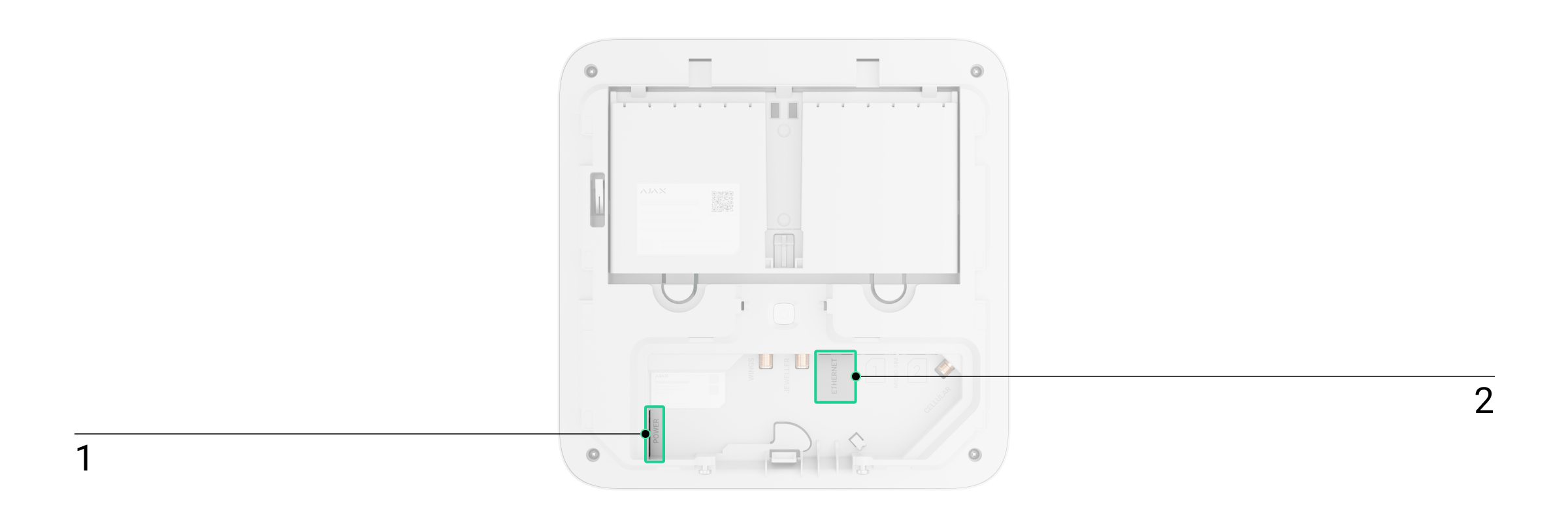
1 — power cable connector.
2 — Ethernet cable connector. - Install SIM cards:

1 — first micro SIM slot.
2 — second micro SIM slot. - Install the internal battery.
Use only Superior Internal Battery (16h) or Superior Internal Battery (60h). We do not guarantee correct device operation on third-party batteries, as they may cause the hub to fail.
- Hold down the hub’s power button. Once the hub turns on, the LED logo will light up.
- Wait for the control panel to connect to the internet. The green LED logo indicates that the hub is ready for operation.
- Add the hub to the system and install the hub.
If Ethernet connection fails
If the Ethernet connection is not established, disable proxy and MAC address filtration and activate DHCP in the router settings. The hub will automatically receive an IP address. After that, you can assign a static IP address to the hub in the Ajax app.
If SIM connection fails
To connect to the cellular network, you need to install a micro SIM card with a PIN code request disabled and a sufficient amount of funds on the account to pay for services as per the operator’s tariff. To disable the PIN code request, insert the SIM card into the phone.
If the hub fails to connect to the cellular network, use Ethernet to configure the network parameters: roaming, APN access point, user name, and password. To find out these parameters, contact the support service of your mobile operator.
Adding a hub to the Ajax app
Use the latest versions of Ajax apps to access all available features and ensure proper system operation. Superior Hub G3 Jeweller can only be added and configured in Ajax PRO apps.
After adding a hub to your account, you become the admin of the device. Admins can invite other users to the system and determine their rights. You can connect up to 50 users to Superior Hub G3 Jeweller.
Each PRO account connected to the hub, as well as the security company profile, is considered a user of the system.
Changing or removing the admin from the list of hub users does not reset the settings of the system or connected devices.
If there are already users on the hub, the hub admin, PRO with the rights to configure the system, or the installation company maintaining the selected hub can add your account. You will be notified that the hub has already been added to another account. Contact our Technical Support to determine who has admin rights on the hub.
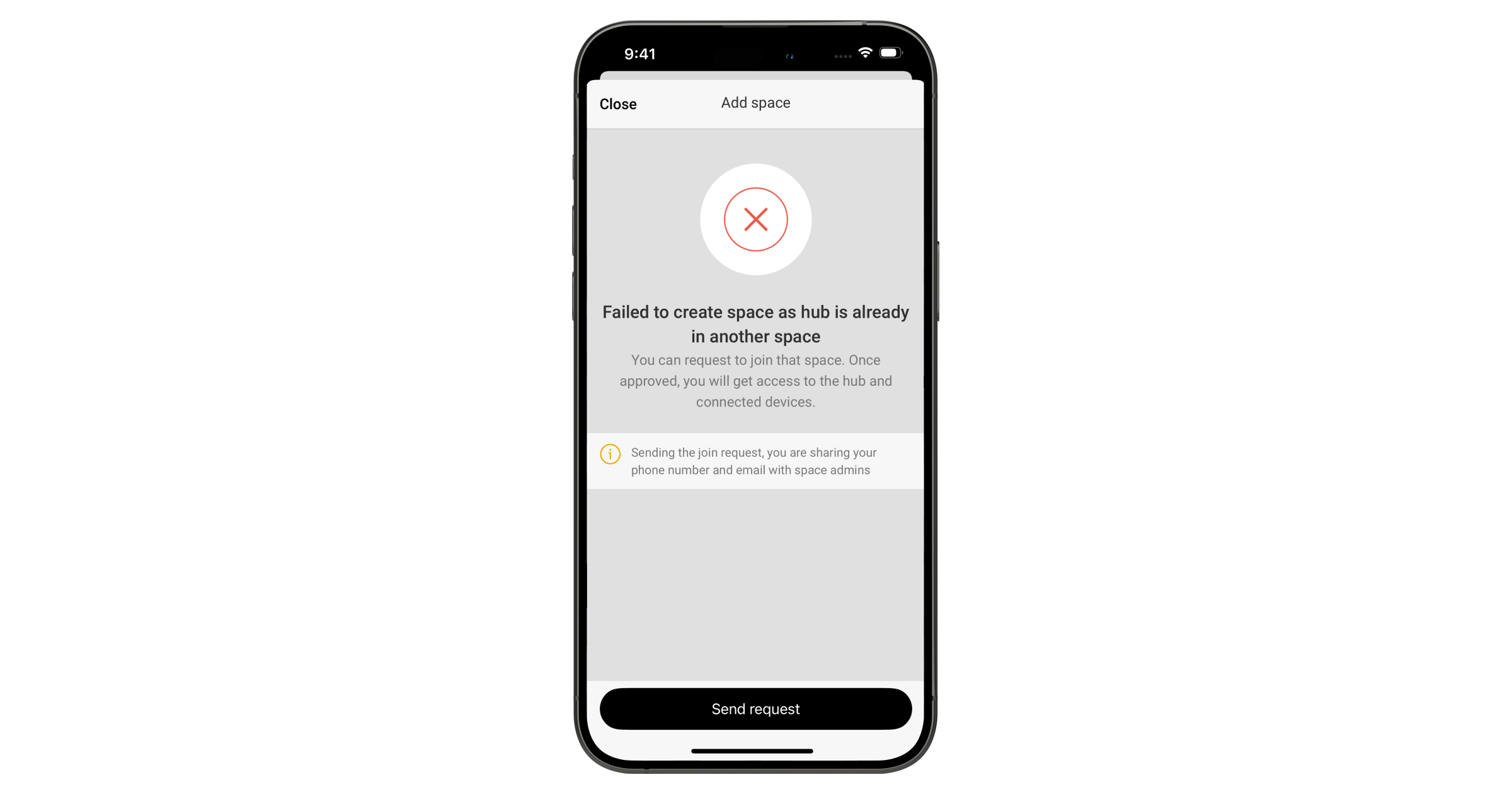
To add a hub to the Ajax PRO app:
- Connect external power, backup battery, Ethernet, and/or SIM cards to the hub.
- Turn on the hub and wait until the connection status LED indicator lights up green or white.
- Open the Ajax PRO app. Allow the app to access the requested features. This will allow you to fully use the capabilities of the Ajax apps and not to miss notifications about alarms or events.
- Ensure you have a space. Create the space if you don’t have one.
- Click Add hub.
- Choose a suitable method: manually or using a step-by-step guidance. If you are setting the system up for the first time, use step-by-step guidance.
Manually
To add a hub manually:
- Assign the hub name.
- Scan the hub QR code or enter the ID manually.
- Wait until the hub is added. After binding, the hub will be displayed in the Devices
 tab of the PRO app.
By step-by-step guidance
If you chose a step-by-step guidance, follow the instructions in the app. Upon completion, the hub and connected devices will be displayed in the Devices tab of the PRO app.
Selecting the installation site
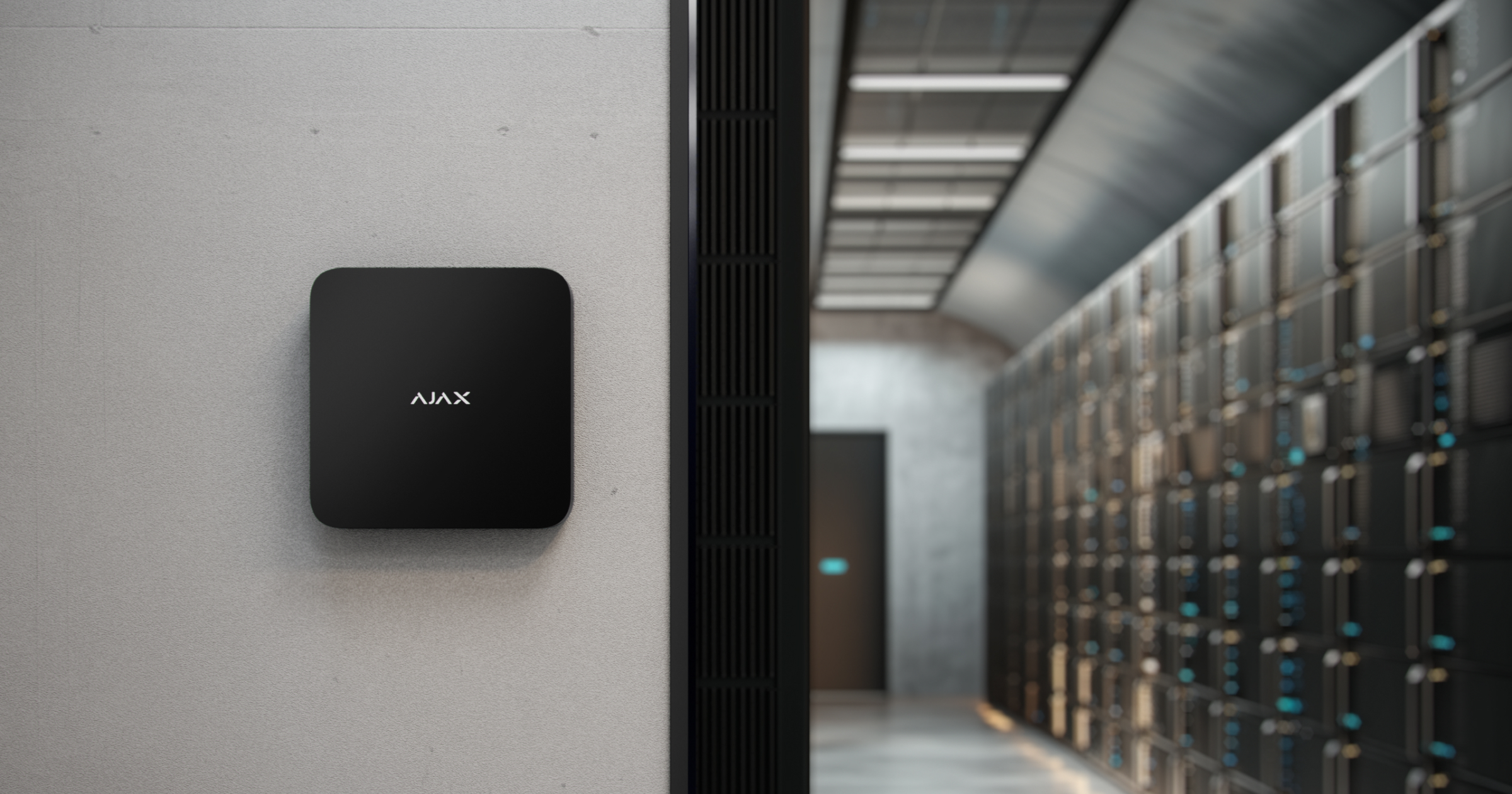
Superior Hub G3 Jeweller is intended for indoor installation only.
Before installing the hub, make sure that you have selected the optimal location: the SIM card demonstrates consistent signal reception, all the devices are tested for radio communication, and the hub is hidden from direct view.
During installation and operation of the Ajax security system, adhere to the rules and requirements of regulatory legal acts on electrical safety. Do not disassemble the device while it is energized or use it with a damaged power cable.
The hub should be reliably attached to the vertical surface. We do not recommend using double-sided adhesive tape: it cannot guarantee secure attachment and simplifies the removal of the device.
Where the hub cannot be installed
- Outdoors. This could result in a failure of the control panel.
- Near the metal objects and mirrors. They can cause attenuation or shielding of the radio signal. This could result in the loss of connection between the hub and Ajax devices. If it is necessary to install in such condition, use ExternalAntenna to overcome obstacles of the signal.
- In places with high levels of radio interference. This could result in the loss of connection between the hub and wireless Ajax devices or false notifications about security system jamming. If necessary, use ExternalAntenna to move the reception spot.
- Less than 3 ft away from the router and power cables. This could result in the loss of connection between the hub and wireless devices.
- Less than 3 ft away from devices. This could result in the loss of connection between the hub and these devices.
- In places where the hub will have a signal strength of 1 or 0 bars with connected devices. This could result in the loss of connection between the hub and these devices. Use ExternalAntenna if necessary.
- Inside premises with temperature and humidity beyond the permissible limits. This could result in a failure of the control panel.
- In places with no cellular signal or 1 bar signal strength. We do not guarantee correct operation of the device with a low cellular signal strength. Use ExternalAntenna if necessary.
Installation
Before installation, make sure that you have selected the optimal location for the device and that it complies with the requirements of this manual.
To install Superior Hub G3 Jeweller:
- Prepare the place for running cables in advance by carefully breaking off the perforated part of the Superior Hub G3 Jeweller enclosure.

- Run the power and Ethernet cables and cables from ExternalAntenna (if necessary) into the enclosure through the prepared cable entry.
- Secure the enclosure to a vertical surface at the selected installation place with the provided screws using all fixing points. One of them is located in the perforated part above the tamper button, which is triggered if any attempt is made to detach the hub enclosure.
- If necessary, connect ExternalAntenna to the appropriate communication port.

Before installation, make sure you read the ExternalAntenna user manual.
- Install the strain relief clip.
- Put the hub on the SmartBracket mounting panel and secure it with the provided screws.

Do not flip the hub when attaching vertically (for instance, on a wall). When properly fixed, the Ajax logo can be read horizontally.
Fixing the hub on the SmartBracket mounting panel with screws prevents any accidental shifting of the hub and minimizes the risk of device theft.
If the hub is firmly fixed, the attempt to tear it off triggers the tamper, and the system sends a notification.
Preparing to connect devices
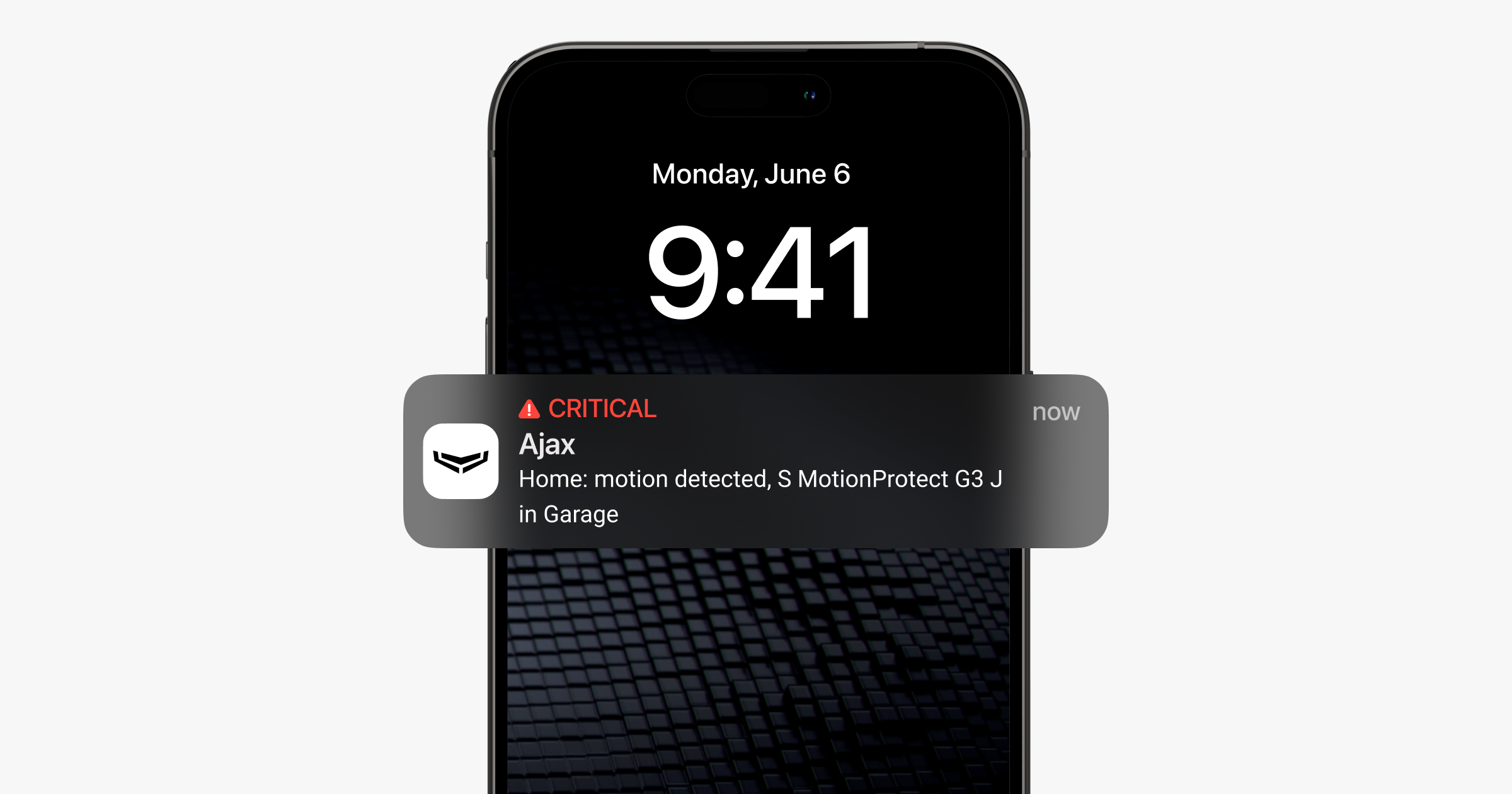
Create at least one virtual room before adding devices to the system. Rooms are needed to group devices and to increase the information content of notifications. Names of devices and rooms are displayed in the text of events and alarms of the Ajax system.
The hub is incompatible with other hubs, uartBridge, and ocBridge Plus.
To add a device to the hub, in the PRO app:
- Go to the Devices tab and tap Add device.
- Assign a name to the device.
- Scan the QR code or enter the device ID manually. A QR code with ID is placed on the device enclosure. Also, it is duplicated on the device packaging.
- Select a virtual room and a security group (if the group mode is enabled).
- Tap Add, and the countdown will begin.
- Follow the instructions in the app to connect the device.
- Repeat steps 1–6 to add any required devices.
To add a device to the hub, the device should be located within the hub’s radio communication range — at the same secured premises.
Malfunctions
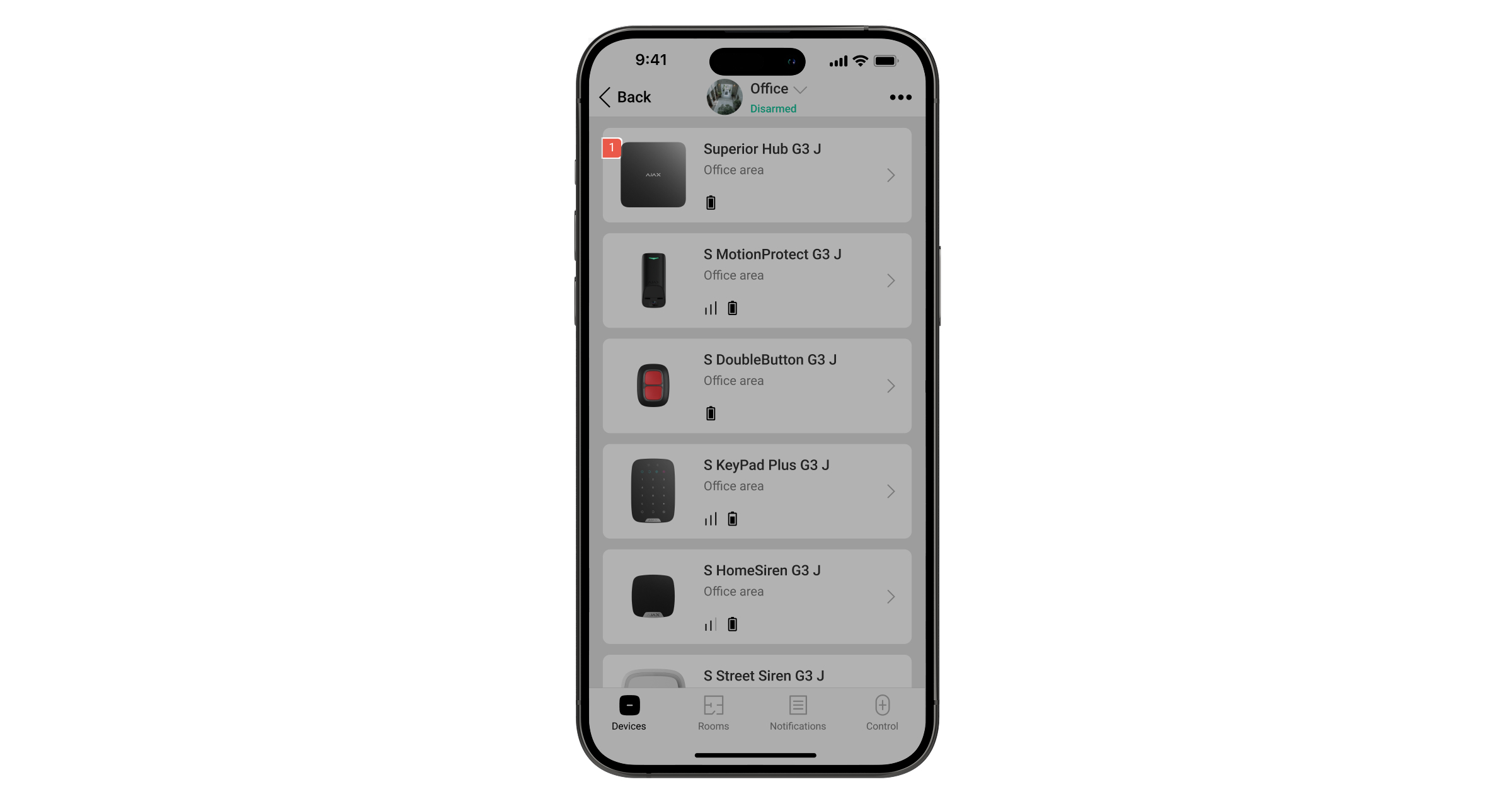
The hub may notify about malfunctions. Tapping on  opens the list of all malfunctions. The Malfunctions field is available in device States and is displayed only if a malfunction is detected, e.g.:
- Battery isn’t found.
- Battery doesn’t charge.
- Flash memory error.
Icons
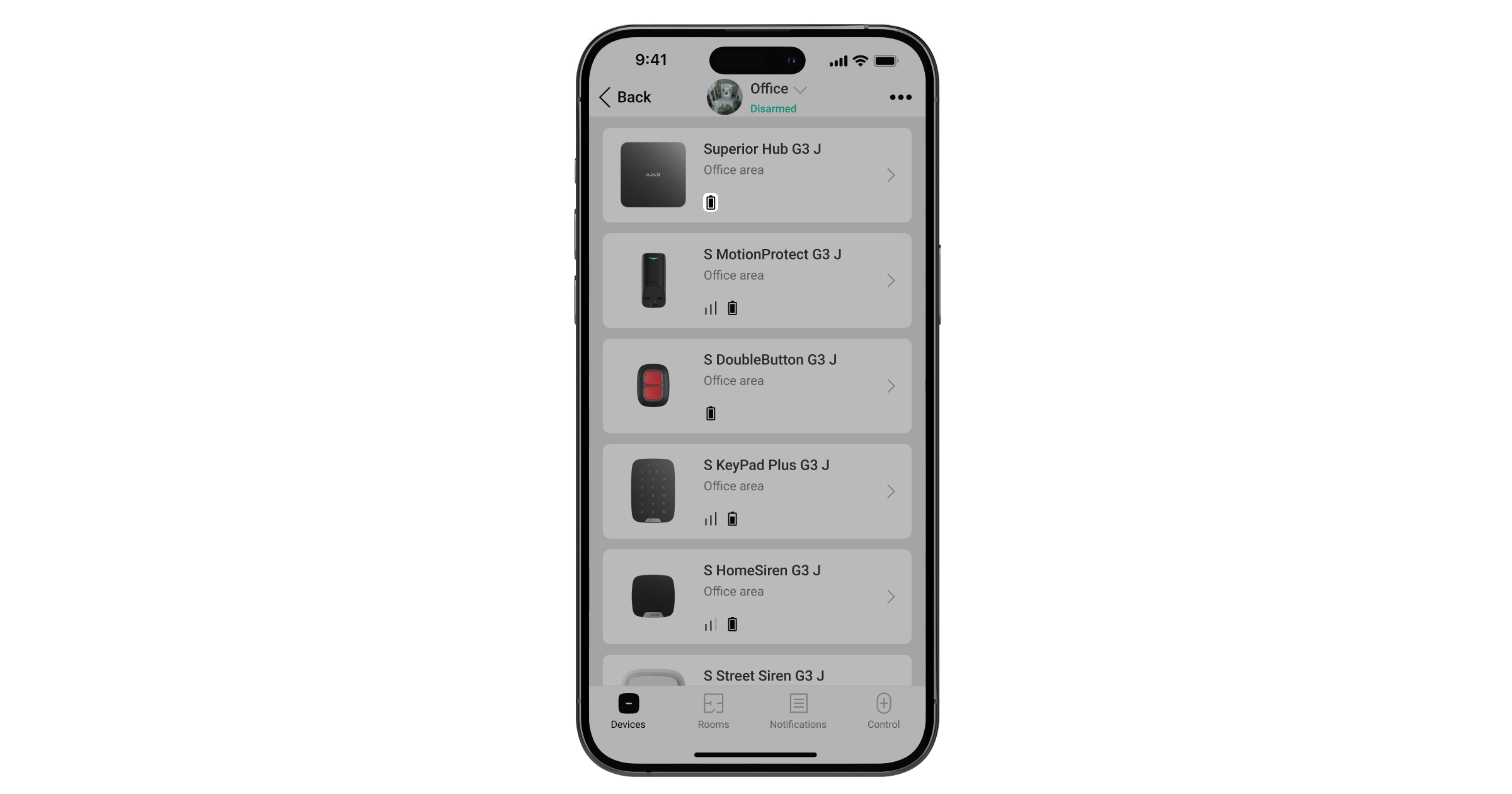
Icons display some of the Superior Hub G3 Jeweller statuses. You can view them in the Ajax app, in the Devices tab.
| Icon | Meaning |
 |
The hub operates in the 2G network. |
 |
The hub operates in the 4G (LTE) network. |
 |
No SIM cards. Insert at least one SIM card. |
 |
The SIM card is faulty or has a PIN code set up. Check SIM card operation in the phone and disable the PIN code request. |
 |
The hub battery charge level. Displayed in 5% increments. |
 |
An internal battery is not connected. |
 |
Superior Hub G3 Jeweller malfunction detected. Open hub states for details. |
 |
The hub is directly connected to the monitoring station of the security company. The icon is not displayed if direct connection is not available or not configured. |
 |
The hub is not directly connected to the central monitoring station of the security company. The icon is not displayed if direct connection is not available or not configured. |
 |
The hub is in the Saving mode state. |
States
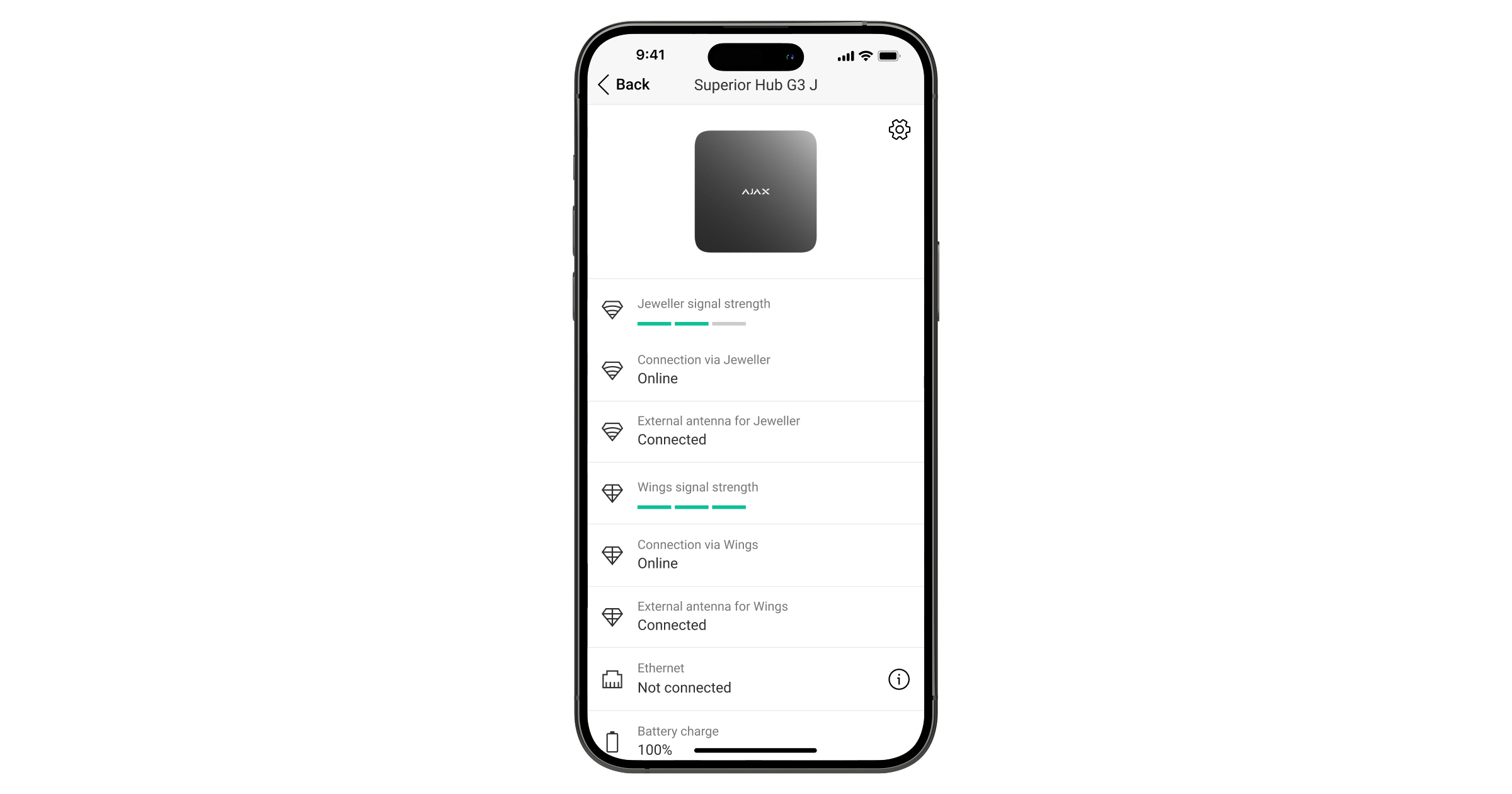
States can be found in the Ajax app:
- Go to the Devices tab.
- Select Superior Hub G3 Jeweller from the list.
| Parameter | Meaning |
| Malfunction |
Tap the The field appears only if a malfunction is detected. |
| Cellular signal strength |
The signal strength of the active SIM mobile network. Install the hub in places where the cellular communication level reaches 2–3 bars. In areas with poor signal reception, it is recommended to install Ajax ExternalAntenna. If the hub is installed in a place with weak or unstable signal strength, it will not be able to call or send an SMS about an event or alarm. |
| External antenna for cellular | External antenna connection status:
External antenna breakage detection is possible only when the hub enclosure is closed properly. |
| Wi-Fi signal strength | Wi-Fi signal strength via Wi-Fi communication channel. The recommended value is 2–3 bars. |
| External antenna for Jeweller | External antenna connection status:
External antenna breakage detection is possible only when the hub enclosure is closed properly. |
| External antenna for Wings | External antenna connection status:
External antenna breakage detection is possible only when the hub enclosure is closed properly. |
| Connection | The status of connection between the hub and Ajax Cloud:
If the hub is not connected to the server, the icons of the hub and all connected devices become semi-transparent in the list of devices. |
| Battery charge |
Hub backup battery charge level. Displayed in 1% increments. At a charge level of 20% and below, the hub will report low battery charge. |
| Lid | The status of tampers that respond to dismantling or opening of the hub enclosure:
The hub detects enclosure lid opening if either or both tamper buttons are triggered. |
| External power | External power supply connection status:
|
| Cellular data | Mobile internet connection status of the hub:
If the cellular signal strength reaches 1–3 bars, and the hub has enough funds and/or has bonus SMS/calls, it will be able to call and send SMS, even if this field displays the Not connected status. |
| Wi-Fi | Internet connection status of the hub via Wi-Fi:
|
| Ethernet | Internet connection status of the hub via Ethernet:
|
| SIM 1 |
The number of the SIM card installed in the first slot. To copy the number, click on it. If the phone number is displayed as an Unknown number, the operator has not written it to the memory of the SIM card. |
| SIM 2 |
The number of the SIM card installed in the second slot. To copy the number, click on it. If the phone number is displayed as an Unknown number, the operator has not written it to the memory of the SIM card. |
| Average noise (dBm) |
Average noise in the radio channel. Measured in the place where the hub is installed. The first two values show the level at Jeweller frequencies, and the third — at Wings frequencies. The acceptable value is –80 dBm or lower. For example, –95 dBm is considered acceptable, and –70 dBm is invalid. |
| Monitoring station | The status of direct connection of the hub to the central monitoring station of the security company:
If this field is displayed, the security company uses direct connection to receive events and security system alarms. |
| Scheduled wake-up |
The status of the scheduled wake-up feature. The feature allows setting the date and time when the hub wakes up on demand from the battery saving mode and becomes active for configuration and management. The available states are:
Tap |
| Hub model |
Hub model name. |
| Hardware version | Superior Hub G3 Jeweller hardware version. Not updated. |
| Firmware |
Superior Hub G3 Jeweller firmware version. Updates remotely. |
| Device ID |
Identifier (first 8 digits of the serial number) of the hub. The identifier is located on the device box and on the board under the QR code. |
| IMEI | A unique 15-digit serial number for identifying the hub’s modem on a GSM network. It is shown only when a SIM card is installed in the hub. |
 to open the feature settings. Settings are available only in
 Settings
The control panel settings can be changed in Ajax PRO apps. In order to change the settings:
- Log in to the Ajax PRO apps.
- Select an object from the list.
- Go to the Devices tab.
- Select a hub.
- Go to its Settings by clicking on the gear icon
 .
. - Select a settings category and make changes. After making changes, click Back to save the new settings.
The hub name is displayed in the SMS and push notification text. The name can contain up to 12 Cyrillic characters or up to 24 Latin characters.
To change it, click on the pencil icon  and enter the new hub name.
Selection of the hub virtual room. The room name is displayed in the SMS and push notification text.
Settings for wired Internet connection.
- Connection via Ethernet — enables and disables the hub Ethernet module.
- Connection type — selection of a method for the hub to obtain an IP address. If DHCP is selected, the hub automatically obtains an IP address and other network settings. Static allows you to manually set up the IP address and other network settings for the hub.
- IP address — hub IP address.
- Subnet mask — mask of the subnet in which the hub operates.
- Gateway — gateway used by the hub.
- DNS — DNS of the hub.
Settings of the mobile network and installed SIM cards. In the main menu, you can edit the settings that relate to both SIM cards, and in the sub-menu — the private parameters of SIM cards.
Modem settings
- Cellular data — disables and enables the hub cellular module.
- Roaming — if this option is active, the SIM cards can work in roaming.
- Ignore network registration error — if this option is active, the hub ignores errors when trying to connect to the network via a SIM card. Activate this option if the SIM card cannot connect to the network.
- Disable communication check with the operator — if this option is active, the hub ignores operator communication errors. Activate this option if the SIM card cannot connect to the network.
SIM cards
- SIM 1 — displays the number of the SIM card installed. If the phone number is displayed as an Unknown number, the operator has not written it to the memory of the SIM card. Clicking on the field opens the settings of this SIM card.
- SIM 2 — displays the number of the SIM card installed. If the phone number is displayed as an Unknown number, the operator has not written it to the memory of the SIM card. Clicking on the field opens the settings of this SIM card.
SIM card settings
APN, Username, and Password — settings for connecting to the Internet via a SIM card. To find out the settings of your cellular operator, contact your provider’s support service. APN settings are applied only after successful connection with new parameters. If the connection attempt fails, the hub continues to work with the previous APN settings.
Mobile data usage. The menu contains information about mobile traffic used by the Ajax system, allowing you to reset statistics and check the balance of the SIM card.
The data is calculated on the hub and may differ from the operator’s statistics. This is because each operator calculates incoming and outgoing traffic individually.
- Incoming — the amount of data received by the hub. Displayed in KB or MB.
- Outgoing — the amount of data sent by the hub. Displayed in KB or MB.
Reset statistics — resets statistics on incoming and outgoing traffic.
Check balance
USSD code. Enter the code that is used to check the balance in this field. For example, *111#. To send a request, after entering the code, click Check balance. The request result will be displayed under the balance check button.
Communication method
The setting allows selecting the preferred antenna for transmitting cellular data:
- Auto-switching between antennas — the hub will prioritize Ajax ExternalAntenna if it is available (connected and undamaged).
- External — the hub does not switch to an internal antenna and tries to use only the external one.
- Built-in — the hub uses an internal antenna.
Settings for Wi-Fi Internet connection. The general list displays all networks available to the hub.
- Wi-Fi — allows you to enable and disable Wi-Fi on the hub. After selecting the network, its settings are opened:
- DHCP / Static — selection of a method for the hub to obtain an IP address. If DHCP is selected, the hub automatically obtains an IP address and other network settings. Static allows you to manually set up the IP address and other network settings for the hub.
- IP address — hub IP address.
- Subnet mask — mask of the subnet in which the hub operates.
- Gateway — gateway used by the hub.
- DNS — DNS of the hub.
- Forget this network — after pressing, the hub deletes the network settings and no longer connects to it.
Setting up keypad passwords for people who are not registered in the system.
You can create a password for people who are not added to the space. This is convenient, for example, to provide a cleaning company with access to security management. Knowing the access code, you just need to enter it on the Ajax keypad to arm or disarm the system.
To set up an access code for an unregistered person in the system:
- Press Add code.
- Set up Username and Access Code.
- Press Add.
If you want to set up a duress code, change an access code, settings for access to groups, Night mode, code ID, temporarily disable or delete this code, select it in the list and make changes.
The created access codes are valid for all keypads connected to the hub. Superior Hub G3 Jeweller supports up to 200 access codes.
The access code should contain from 4 to 6 digits. Numbers from 0 to 9 can be applied to every digit.
Superior Hub G3 Jeweller supports more than 1,000,000 variations of codes.
This setting is only available in Ajax PRO apps
Set the requirements for the length of passcodes that are used for users’ authorization and access to the system. You can select Flexible (4 to 6 symbols) option or define the fixed code length: 4 symbols, 5 symbols, or 6 symbols.
Note: when you set the fixed code length, the system resets all access codes configured before.
The fixed code length is required for the Easy armed mode change feature that allows disarming the system without pressing the  Disarm button on the keypad after entering a passcode or using an access device.
Scheduled arming/disarming settings. The security schedule can be used for individual groups and for the entire object, as well as for the Night mode.
Starts the Detection zone test for connected devices. The test allows you to check the operation of devices and their alarm detection zone.
Setting the polling period between the hub and connected devices. The settings indicate how often the hub communicates with devices and how fast a connection loss is detected.
- Device ping interval, sec — the frequency of polling of connected devices by the hub, set in the range from 12 to 300 seconds. The default value is 36 seconds.
- Number of missed pings to determine connection failure — counter of undelivered packets, set in the range from 3 to 60. The default value is 8 packets.
Do not decrease the default values of the ping interval and ping period unless it is necessary.
The time before sending a message regarding the loss of connection between the hub and the device are calculated using the following formula:
Device ping interval × Number of missed pings to determine connection failure
The shorter the ping period, the faster the hub will know about the events of the connected devices, and the devices will receive hub commands. Information about alarms and sabotage is transmitted instantly, regardless of the ping interval. Decreasing the ping period will affect the battery life of wireless devices.
The ping interval limits the maximum number of connected devices:
| Interval | Connection limit |
| 12 s (Grade 3 compliant) | 39 devices |
| 24 s (Grade 3 compliant) | 79 devices |
| 36 s (by default) | 119 devices |
| 48 s | 159 devices |
| 72 s | 200 devices |
| 84 s | 250 devices |
For systems compliant with EN 50131 Grade 3, the loss of connection with a device must be detected within 100 seconds. To meet this requirement, the device ping interval can be set to 24 s with 4 missed pings (24 s × 4 = 96 s) or to 12 s with 8 missed pings (12 s × 8 = 96 s). These configurations limit the maximum number of supported wireless devices to 79 and 39, respectively.
For systems compliant with EN 50131 Grade 2, the loss of connection with a device must be detected within 120 minutes.
Regardless of the ping period settings, up to 10 sirens without Superior Jeweller support and up to 50 keypads with a built-in buzzer that do not support Superior Jeweller can be connected to Superior Hub G3 Jeweller.
Radio interference detection — the following settings ensure system compliance with EN 50131 Grade 3 requirements. There are two options:
- Advanced radio interference detection.
- Send radio interference detection event as alarm — if enabled, the notification of a high level of radio interference will be sent as alarm to all system users.
Communication method
The setting allows selecting the preferred antenna for communication with devices via Jeweller and Wings channels:
- Auto-switching between antennas — the hub will prioritize Ajax ExternalAntenna if it is available (connected and undamaged).
- External — the hub does not switch to an internal antenna and tries to use only the external one.
- Built-in — the hub uses an internal antenna.
This setting is only available in Ajax PRO apps.
Telephony settings allow you to configure an Ajax hub to communicate with a central monitoring station (CMS) via SIP protocol.
In PRO Desktop, a telephony settings template can be created and applied to save time on configuration on multiple systems.
Group of hub service settings. These are divided into two groups: general settings and advanced settings.
General settings
LED brightness
Brightness adjustment of the hub LED indicator.
Firmware update
The menu contains the hub firmware update settings.
- Firmware auto-update configures automatic OS Malevich updates (enabled by default):
- If enabled, the firmware is automatically updated when a new version is available. The system should be disarmed, and external power should be connected to the hub.
- If disabled, the system does not update automatically. If a new firmware version is available, the app will offer to update the OS Malevich.
- Check for new version allows manually checking and installing firmware updates when available or assigned to the hub. This option is available only when the Firmware auto-update setting is enabled.
If the hub firmware is outdated, an error may occur when adding a device to the hub. In this case, the system will prompt the user to open the Firmware update section in the Service settings and check for a new firmware version. If available, the user can proceed with an on-demand firmware update.
Hub system logging
This setting allows you to select the transmission channel for the hub logs or disable their recording:
- Ethernet — system logs are transmitted over the wired Internet.
- Off — logging is disabled.
Logs are files containing information about system operation. Do not disable the logs as this information may be helpful in case of errors in the operation of the system. Logs are transmitted via Ethernet only.
Delaying notifications of external power loss
Settings for the delay time when sending an external power loss notification.
You can select a delay time from 1 minute to 1 hour with a selection interval of 1 minute.
‘While hub offline’ events amount
Events during communication failure with the server are recorded in the hub buffer and will be delivered to Ajax apps after the connection is restored.
This setting allows you to choose the number of the last events, that hub will send to Ajax apps after returning online.
You can select between 100 (default value) and 1000 events with increment of 50 events.
Advanced settings
PD 6662 setting wizard
Opens a step-by-step guide on how to set up your system to comply with the British security standard PD 6662:2017.
Server connection
Communication settings between the hub and the Ajax Cloud server:
- Delay of server connection failure alarm, sec. The delay is necessary to reduce the risk of false notification of a lost connection with the Ajax Cloud server. Activated after 3 unsuccessful hub–server polls. The delay is set in the range of 30 to 600 s. The recommended default value is 300 s.
- Hub-server polling interval, sec. Frequency of sending pings from the hub to Ajax Cloud server. It is set in the range of 10 to 300 s. The recommended default value is 60 s.
The time before sending a notification regarding the loss of communication between the hub and the Ajax Cloud server is calculated using the following formula:
(Ping interval × 3) + Time filter.
With the default settings, Ajax Cloud registers the hub loss in 8 minutes:
(60 s * 3) + 300 s = 8 min.
- Get notified of server connection loss without alarm. Ajax’s apps can notify about the hub-server connection loss in two ways: with a standard push notification signal or with a siren sound (enabled by default). When the option is active, the notification comes with a standard push notification signal.
- Notify of connection loss over channels. The Ajax security system can notify both the users and the security company about the loss of connection between the hub and the Ajax Cloud server even via one of the communication channels.
In the menu, you can select the communication channels via which the system will notify about the loss of connection (Ethernet and/or cellular), as well as the transmission delay of such notifications.
- Loss notification delay, min — time of the delay before sending the notification about the loss of connection via one of the communication channels. Set in the range from 3 to 30 minutes.
The time of sending a notification about the loss of connection via one of the communication channels is calculated using the following formula:
(Ping interval × 3) + Time filter + Notification delay.
Sounds and alerts
The menu contains three groups of settings: siren activation parameters, siren after-alarm indication, and beep with keypad activation parameters.
Siren activation parameters
If lid of hub or any detector is open. If enabled, the hub activates the connected sirens if the body of the hub, detector, or any other Ajax device is open.
If in-app panic button is pressed. If enabled, the hub activates the connected sirens if the panic button was pressed in the Ajax app.
Disable the siren response to Ajax SpaceControl Jeweller panic button pressing in the key fob settings in the Ajax app (Devices → Ajax SpaceControl Jeweller → Settings ).
Restart alarm signal on triggering of each detector. If enabled, each new alarm from the intrusion detector will restart the siren alarm. You can disable this setting so that the siren only reacts to alarm from the first triggered detector.
Setting the siren after-alarm indication
This setting is only available in Ajax PRO apps
The siren can inform about alarms in the armed system by means of LED indication. Thanks to this feature, users and passing patrols of security companies can see that the system was triggered.
Beep with keypad activation parameters
This setting is only available in Ajax PRO apps
The keyboards connected to the hub will emit an audible sound to inform of malfunctions. To activate the sound notifications enable toggles: If any device is offline and If battery of any device is low.
Sound notifications of malfunctions are supported by Ajax keypads with the following firmware versions or higher:
- 5.57.1.1 for KeyPad Jeweller;
- 5.57.5.0 for KeyPad Plus Jeweller.
Battery settings
The menu contains the following settings:
- Battery power saver;
- Charging mode.
This setting is only available in Ajax PRO apps
Battery power saver
The Save hub backup battery charge setting allows for extending the backup battery life when an external power supply is unavailable. When this setting is enabled, the hub switches to standby mode once it loses the external power supply.
To save the backup battery charge, the hub disables its connection channels (cellular network, Ethernet, Wi-Fi) when it switches to standby mode. Therefore, the hub in standby mode is not connected to Ajax Cloud and CMS until any system event occurs. In Ajax apps, the hub and devices added to it will be greyed out and unavailable for configuration or control; the hub will be in the Saving mode state, and devices added to it will be Offline. The space in the spaces list will be labeled with the additional Saving mode state.
The standby mode doesn’t affect the system operation. Any detector triggering activates the hub for a specified time to transmit the event to users and CMS. During standby mode, the hub LED flashes red every 30 seconds, and the LED brightness is decreased to the minimum.
If the hub is in standby mode, switching arming modes is possible only by using a keypad or a key fob. Switching system arming modes and configuring the hub in standby mode via Ajax apps are not provided.
Enable Save hub backup battery charge to configure the hub operation time:
| Setting | Meaning |
| Activity period | The time the hub remains connected to Ajax Cloud after any system event occurs is set to 10 minutes by default. However, you can adjust this time from 5 minutes to 1 hour. |
| Server polling interval | The time between connections of the hub in standby mode to the server is set to 6 hours by default. However, you can adjust this time from 1 hour to 24 hours. |
The Battery power saver feature allows for extending the backup battery life up to 300 hours for Superior Hub G3 Jeweller when using Superior Internal Battery (60h). This duration depends on system configuration and the number of devices added to the hub.
When the Battery power saver feature is enabled, your system does not comply with EN 50131 Grade 2, 3.
Note: if your system includes at least one range extender added to the hub via Ethernet, the hub will not switch to standby mode. This is necessary to keep the connection with devices added via the range extender.
For systems with voice modules: the CMS operator can connect and communicate via voice modules only during the hub Activity period when the hub stays connected to Ajax Cloud. The ongoing call can not prolong the hub activity period; therefore, the call will end automatically once the hub switches to Saving mode.
Fire detectors settings
Configuring the Interconnected fire detector alarm. The function activates the built-in sirens of all Ajax fire detectors if at least one of them triggers.
System integrity check
This parameter is responsible for checking the state of security detectors, devices and followed groups before arming the system. System integrity check is disabled by default.
Alarm confirmation
This setting is only available in Ajax PRO apps
This is a special event that the hub sends to the CMS and system users if several devices specified by the admin have triggered within a specified period of time.
By responding to confirmed alarms, the security company and the police reduce the number of visits on false alarms.
Restoration after alarm
This setting is only available in Ajax PRO apps
The feature does not allow arming the system if an alarm has been registered previously. To arm the system, an authorized user or PRO should restore it. The types of alarms that require system restoration are defined when configuring the function.
The function eliminates situations when the user arms the system with detectors that generate false alarms.
Arming/disarming process
This setting is only available in Ajax PRO apps
The first Compliance with standard option allows selecting a specific standard to set the security system according to existing requirements. Once you select the required standard, the menu will show the appropriate arming/disarming settings below. The following standards are available:
- EN 50131 — European standard for intrusion and hold-up alarm systems, which also describes the security grades concept.
- PD 6662 — British standard for intrusion and hold-up alarm systems, aimed to reduce the number of unconfirmed alarms and ensure police reaction only to real threats.
- VdS — German standard for intruder and hold-up alarm systems, which regulates arming/disarming process.
- ANSI/SIA CP-01-2019 — American standard for security systems that regulates features and requirements to reduce false alarms caused by users or equipment.
EN 50131
Once EN 50131 is activated, you can set the parameters of the functions Two-stage arming, Exit time restart, and Exit error in the arming settings, as well as set the Alarm transmission delay in the disarming settings.
PD 6662
Once PD 6662 is selected, the menu shows the number of arming/disarming settings that allow configuring the system to comply with standard requirements.
Use the corresponding step-by-step guide in the Ajax PRO app for a quick and convenient system setup according to PD 6662. Go to Hub → Settings → Service → PD 6662 setting wizard and follow the app prompts.
VdS
Once VdS is selected, all devices in the system operate without delay when leaving, but entry delays will still work.
The system automatically checks that all doors and locks are closed. The door is locked with the third-party Blocking element when arming the system. Additionally, the system checks whether the door is blocked to ensure that the system is armed according to the unavoidability principle (German: Zwangsläufigkeit).
The system can’t be armed if it has malfunctions. If there are any malfunctions or the door is not locked, the system notifies of the unsuccessful arming event.
ANSI/SIA CP-01-2019
An Ajax system controlled by the hub with OS Malevich 2.19 or higher can be configured following the requirements of ANSI/SIA CP-01-2019.
Only Hub 2 (4G) Jeweller and Hub 2 Plus Jeweller are certified according to ANSI/SIA CP-01-2019.
Once ANSI/SIA CP-01-2019 is selected, you can configure Exit time restart and Unvacated premises for the arming settings. For the disarming settings, you can select what devices should make an annunciation on Alarm cancellation or Alarm abort and adjust the Alarm abort window timeout.
Also, this standard requires enabling a number of features for the system, such as Delay when entering/leaving, cross zoning, Devices auto deactivation, and system testing. These features are configured in the hub and certain device settings.
Devices auto deactivation
This setting is only available in Ajax PRO apps
The function allows you to ignore alarms and/or other device events without removing them from the system. Events of disabled devices will not be sent to the CMS and security system users.
There are three types of Devices auto deactivation: by timer, by number of alarms and by number of similar events. It is also possible to manually deactivate a specific device.
LED indication
This setting is only available in Ajax PRO apps
In this menu, you can select the system states and events that the hub’s LED indicators will display. One of two functions can be chosen:
- Hub–server connection — hub’s LEDs display if a hub is connected to the power supply and the internet.
- British disco — hub’s LEDs display information about system alerts and malfunctions, security mode changes, and delays when entering/leaving.
After-alarm indication
Select events that sirens or keypads with in-built LED will indicate with regular double flashing until the system is disarmed.
- Confirmed intrusion/hold-up alarm.
- Single intrusion/hold-up alarm.
- Lid opening.
When pressed, opens the Superior Hub G3 Jeweller user manual in the Ajax app.
Menu for automatically transferring devices and settings from another hub. Note that you are in the settings of the hub on which you want to import data.
Removes your account from the hub. All settings, paired detectors, and devices, as well as invited users, are saved in the hub’s memory.
Hub settings reset
Resetting the hub to the factory settings:
- Turn on the hub if it is off.
- Remove all users and installers from the hub.
- Hold the power button for 30 s — the LED indicator on the hub board will start blinking red.
- Remove the hub from your account.
Space settings
Settings can be changed in the Ajax app:
- Select the space if you have several of them or if you are using a PRO app.
- Go to the Control
 tab.
tab. - Go to Settings by tapping the gear icon in the bottom right corner.
- Set the required parameters.
- Tap Back to save the new settings.
Indication
The hub has two LED indication modes:
- Hub–server connection.
- British disco.
Hub–server connection
Hub–server connection mode is enabled by default. The hub LED has a list of indications showing the system state or events occurring. Superior Hub G3 Jeweller can light up red, white, purple, yellow, blue, or green, depending on the state.
Superior Hub G3 Jeweller states can also be monitored in the Ajax apps.
| Indication | Event | Note |
| Lights up white. | At least two communication channels are connected: Ethernet and one or two SIM cards. | When operating on a backup battery only, the indicator will blink every 10 seconds. |
| Lights up green. |
One communication channel is connected: Ethernet or one/two SIM cards. |
When operating on a backup battery only, the indicator will blink every 10 seconds. |
| Lights up red. | The hub has no connection to the internet or the Ajax Cloud service. | When operating on a backup battery only, the indicator will blink every 10 seconds. |
| Lights up continuously for 3 minutes, then blinks every 10 seconds. |
The external power supply is disconnected (if there is a connected backup battery). |
The color of the indication depends on the number of connected communication channels. |
| Blinks red. | The hub is reset to factory settings. |
If you see an indication while using the system that is not listed in this user manual, please contact the Ajax support service.
Access to indications
Superior Hub G3 Jeweller users can see the British disco indication after they:
- Arm/disarm the system using the Ajax keypad.
- Enter the correct user ID or personal code on the keypad and perform an action that has already been performed (for example, the system is disarmed and the disarm button is pressed on the keypad).
- Press the Ajax SpaceControl Jeweller button to arm/disarm the system or activate Night mode.
- Arm/disarm the system using Ajax apps.
All users can see the Changing hub’s state indication.
British disco
The function can be enabled in the hub settings in the PRO app (Hub → Settings → Services → LED indication).
| Indication | Event | Note |
| Changing hub’s state | ||
| White LED flashes once per second. | Two-stage arming or Delay when leaving. | One of the devices is performing Two-stage arming or Delay when leaving. |
| Green LED flashes once per second. | Entry indication. | One of the devices is performing Delay when entering. |
| White LED lights up for 2 seconds. | Arming is completed. | The hub (or one of the groups) is changing its state from Disarmed to Armed. |
| Green LED lights up for 2 seconds. | Disarming is completed. | The hub (or one of the groups) is changing its state from Armed to Disarmed. |
| Alerts and Malfunctions | ||
| Red and purple LED flashes in sequence for 5 seconds. | Confirmed hold-up alarm. |
There is an unrestored state after a confirmed hold-up alarm. The indication is displayed only if Confirmed intrusion/hold-up alarm is enabled in the settings. |
| Red LED lights up for 5 seconds. | Hold-up alarm. |
There is an unrestored state after a hold-up alarm. The indication is not displayed if there is a confirmed hold-up alarm state. The indication is displayed only if Single intrusion/hold-up alarm is enabled in the settings. |
| Red LED flashes. | The number of flashes equals the Device No. of a hold-up device (DoubleButton Jeweller), the first to generate the hold-up alarm. | There is an unrestored state after the confirmed or unconfirmed hold-up alarm. |
| Yellow and purple LED flashes sequentially for 5 seconds. | Confirmed intrusion alarm. |
There is an unrestored state after the confirmed intrusion alarm. The indication is displayed only if Confirmed intrusion/hold-up alarm is enabled in the settings. |
| Yellow LED lights up for 5 seconds. | Intrusion alarm. |
There is an unrestored state after the intrusion alarm. The indication is not displayed if there is a confirmed intrusion alarm condition. The indication is displayed only if Single intrusion/hold-up alarm is enabled in the settings. |
| Yellow LED flashes. | The number of flashes equals the Device No. that first generated the intrusion alarm. | There is an unrestored state after the confirmed or unconfirmed intrusion alarm. |
| Red and blue LED flashes in sequence for 5 seconds. | Lid opening. |
There is an unrestored tamper state or an open lid on any of the devices, or the hub. The indication is displayed only if Lid opening is turned on in the settings. |
| Yellow and blue LED flashes in sequence for 5 seconds. | Other malfunctions. |
There is an unrestored fault state or a malfunction of any device or the hub. The indication is displayed only if Restoration after faults is enabled in the settings. Currently, Restoration after faults is not available in Ajax apps. |
| Dark blue LED lights up for 5 seconds. | Temporary deactivation. | One of the devices is temporarily deactivated or the lid state notifications are disabled. |
| Blue LED lights up for 5 seconds. | Automatic deactivation. | One of the devices is automatically deactivated by an opening timer or the number of detections. |
| Green and blue LED flashes in sequence. |
Alarm timer expiration. |
Displayed after the alarm timer expires (to confirm the alarm). |
When nothing is happening in the system (no alarm, malfunction, lid opening, etc.), the LED displays two hub states:
- Armed/partially armed or Night mode enabled — the LED lights up white.
- Disarmed — the LED lights up green.
Alert indication
If the system is disarmed and any of the indications from the table is present, the yellow LED flashes once per second.
If there are several states in the system, the indications are displayed one by one, in the same sequence as shown in the table.
Additional features
Video surveillance
Superior Hub G3 Jeweller is compatible with Ajax cameras and NVRs and with third-party cameras that support RTSP protocol or SDK integration.
You can calculate the number of cameras and NVRs that can be added to the space using the video device calculator.
Scenarios
Superior Hub G3 Jeweller allows creating 64 scenarios and minimizing the human factor impact on safety. The hub can manage the security of the entire facility or group according to a schedule; activate the smoke machine if intruders enter the room; de-energize the room and turn on emergency lighting in case of fire; shut off water in the event of a leak; control lighting devices, electric locks, roller shutters, and garage doors — when changing the security mode by pressing a button or by a detector alarm.
Scenarios can be used to reduce the number of routine actions and increase productivity. Ajax automation devices respond to changes in temperature and air quality. For example, configure the heating to turn on at low temperatures, control the supply system, humidifier, and air conditioner to maintain a comfortable climate.
Photo verification
Superior Hub G3 Jeweller supports both MotionCam and MotionCam Outdoor motion detectors. When triggered, the detectors take a series of shots you can use to evaluate the unfolding of the events at the facility over time. This relieves users of unnecessary anxiety and prevents security companies from sending unnecessary patrol dispatches.
The detector activates the camera when armed and detects movement. Only users with access to the events feed, as well as authorized employees of the security company can see visual alarm verifications provided that the security system is connected to the monitoring station.
If Photo on Demand function is activated, the detectors can take a photo upon the command of a system user or PRO user with the appropriate rights. The taking of a photo is always registered in the hub’s events feed.
The shots are protected by encryption at every stage of transmission. They are stored on the Ajax Cloud server and are not processed or analysed.
Maintenance
Check the functioning of Superior Hub G3 Jeweller and connected devices on a regular basis. The optimal frequency of checks is once every three months. Clean the hub enclosure from dust, cobwebs, and other contaminants as they emerge. Use a soft, dry cloth that is suitable for equipment care.
Do not use substances that contain alcohol, acetone, petrol, and other active solvents to clean the device.
Technical specifications
Warranty
Warranty for the Limited Liability Company “Ajax Systems Manufacturing” products is valid for 2 years after the purchase.
If the device does not function correctly, please contact the Ajax Technical Support first. In most cases, technical issues can be resolved remotely.
Contact Technical Support:
Manufactured by “AS Manufacturing” LLC