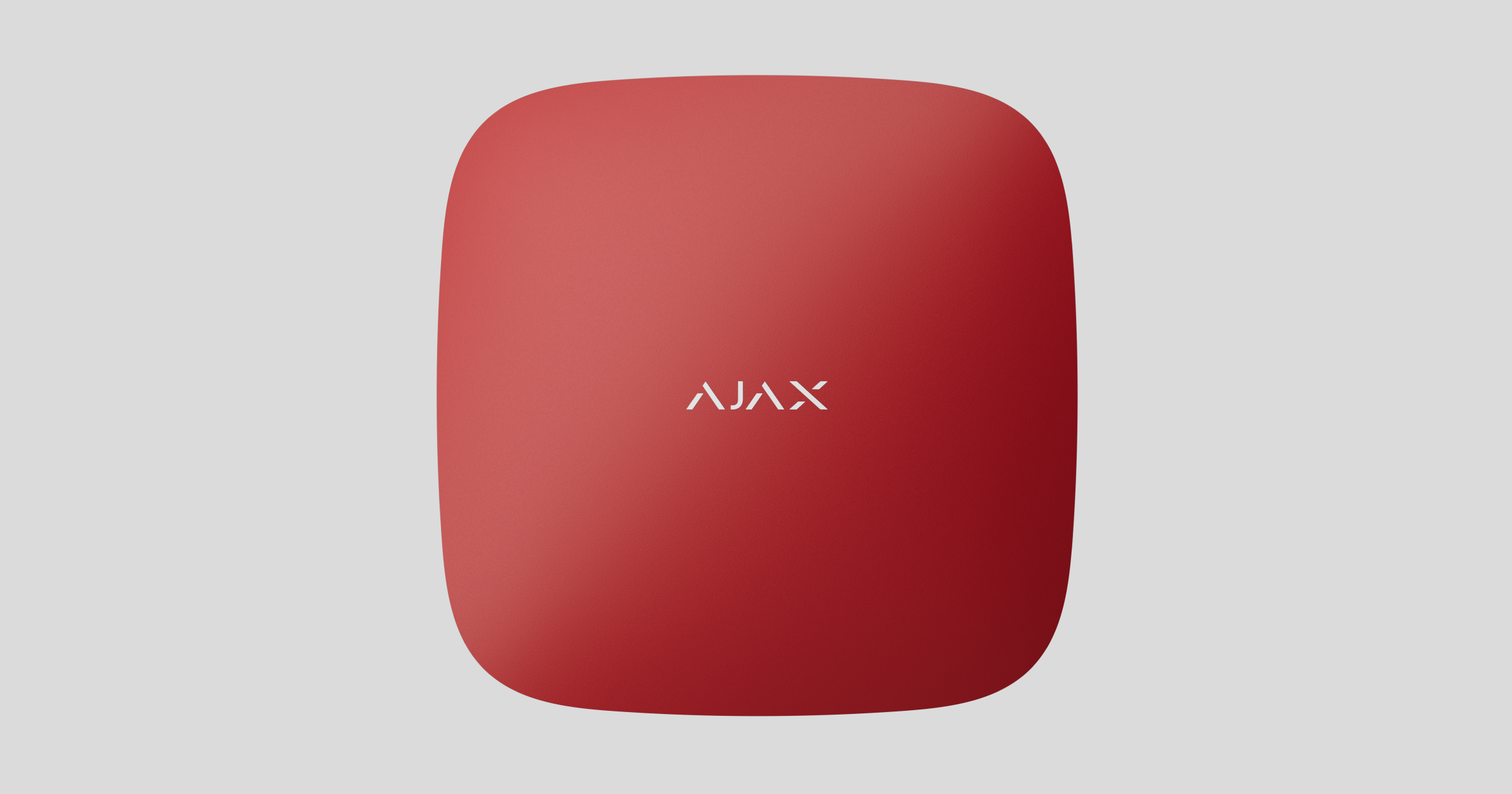
Type4 Hub (4G) Jeweller is a wireless addressable fire alarm central unit of the Ajax system. The device complies with Type 4 fire alarm equipment requirements. The central unit controls the operation of connected devices and interacts with users, PROs, and security companies.
Type4 Hub (4G) Jeweller requires an internet connection to access the Ajax Cloud server. The available communication channels are Ethernet and a SIM card.
Functional elements
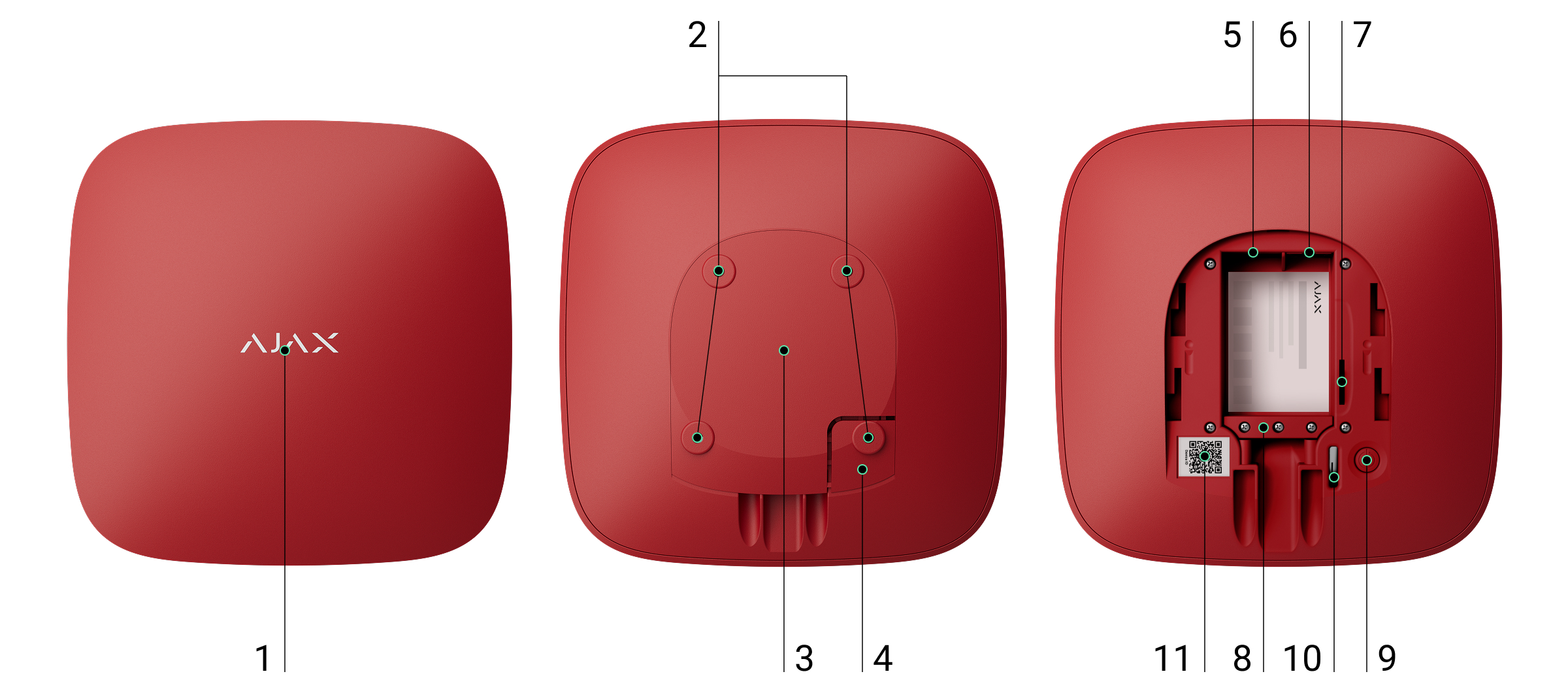
- Logo with an LED indicator.
- Holes to secure the SmartBracket mounting panel to the surface.
- SmartBracket mounting panel. Slide it down to open.
- Perforated part of the mounting panel. It triggers a tamper alarm if someone attempts to detach the device from the surface. Do not break it off.
- Power supply connector.
- Ethernet cable connector.
- Slot for micro SIM.
- Сable retainer clamp.
- Power button.
- Tamper button.
- QR code and ID (serial number) of the device. It is used to add the central unit to an Ajax system.
Operating principle
Type4 Hub (4G) Jeweller monitors the system operation by communicating with added devices via the Jeweller encrypted protocol. The communication range is up to 2,000 m in an open space (for example, without walls, doors, or inter-floor constructions). If the device is triggered, the system immediately raises the alarm, runs scenarios, and notifies the monitoring company and system users about the incident.
The central unit is added to a space — a virtual entity that brings together various autonomous devices installed at the same facility.
OS Malevich
Type4 Hub (4G) Jeweller runs on OS Malevich, a real-time operating system protected against viruses and cyberattacks.
OS Malevich brings new features and functionality to the Ajax system through over-the-air updates. A PRO or a company with firmware update rights can start an update — when available — from the Type4 Hub (4G) Jeweller field in the Devices  tab, or via the central unit states or settings. On-screen instructions help guide the user through the process.
The update takes up to 2 minutes and requires the system to be disarmed, free of active fire alarms, and connected to an external power supply.
Sabotage protection
Type4 Hub (4G) Jeweller has two communication channels for connecting to the Ajax Cloud server: Ethernet and a SIM card. This allows the device to work with multiple communication providers at once. If one channel becomes unavailable, the central unit automatically switches to another and notifies the monitoring station and system users.
If a jamming attempt is detected, the system switches to an idle radio frequency and sends notifications to the monitoring station and users.
No one can turn off the central unit unnoticed. If an intruder attempts to open the central unit enclosure, a tamper alarm is triggered immediately. An alarm notification is then sent to the monitoring company and all system users.
The central unit regularly checks its connection to Ajax Cloud. The ping interval is defined in the central unit settings. When the minimum interval is configured, the server can notify users and the monitoring company as soon as 60 seconds after the connection is lost.
The built-in backup battery ensures up to 15 hours of autonomous operation when the Ethernet connection is switched off. Due to this, the system continues to operate even if the power supply is cut off at the facility. To increase battery life or connect the central unit to a 6 V⎓ or 12–24 V⎓ grid, use a power supply unit: 6V PSU (type A) or 12–24V PSU (type A).
Video surveillance
Type4 Hub (4G) Jeweller is compatible with Ajax cameras and NVRs.
You can calculate the number of cameras and NVRs that can be added to an Ajax space using Video device calculator.
Scenarios
Type4 Hub (4G) Jeweller supports 5 fire alarm scenarios for Type4 Line devices, allowing customization of the system’s response to specific triggers and alarms. These scenarios allow linking devices that can trigger the scenario with devices that can execute it.
Fire alarm scenarios include one general fire alarm scenario, which is present in the system by default, and multiple custom fire alarm scenarios defined by a user.
In addition to fire alarm scenarios, the Type4-certified system supports intrusion scenarios. If both types of scenarios are created in the system, they are organized into separate groups. Also, it is possible to open all scenarios of a specific type by selecting the corresponding tab.
Ajax account
To set up the system, install an Ajax app and log in to your account, or create a new one if you don’t have one. Don’t create a new account for each space, since one account can manage multiple security systems. Where necessary, you can configure separate access rights for each space. Changing the space admin, adding or removing users does not reset the settings of devices added to the space.
Connecting the central unit to Ajax Cloud
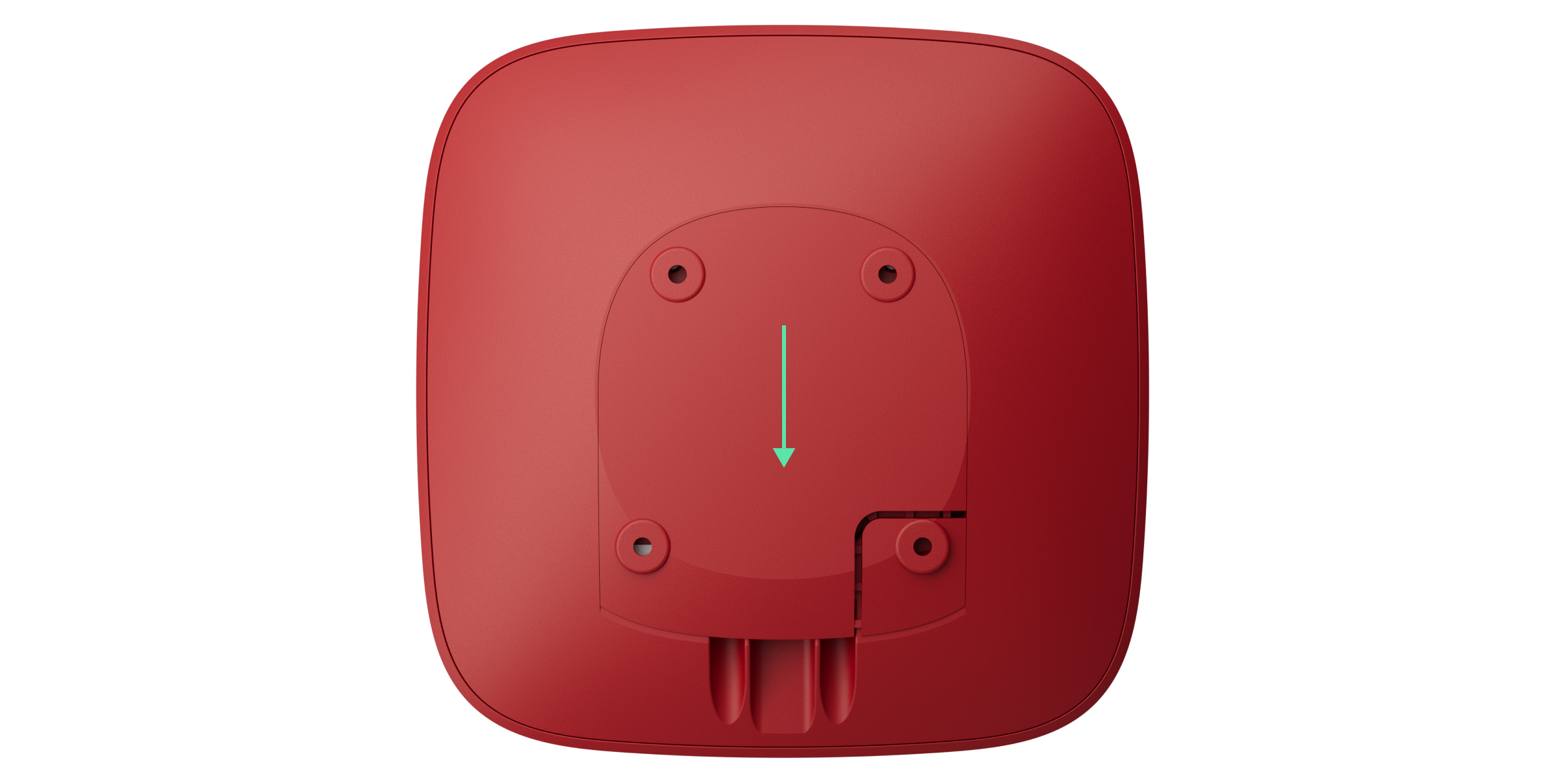
- Remove the SmartBracket mounting panel by shifting it down with force.
- Connect the power supply and Ethernet cables to the appropriate sockets.
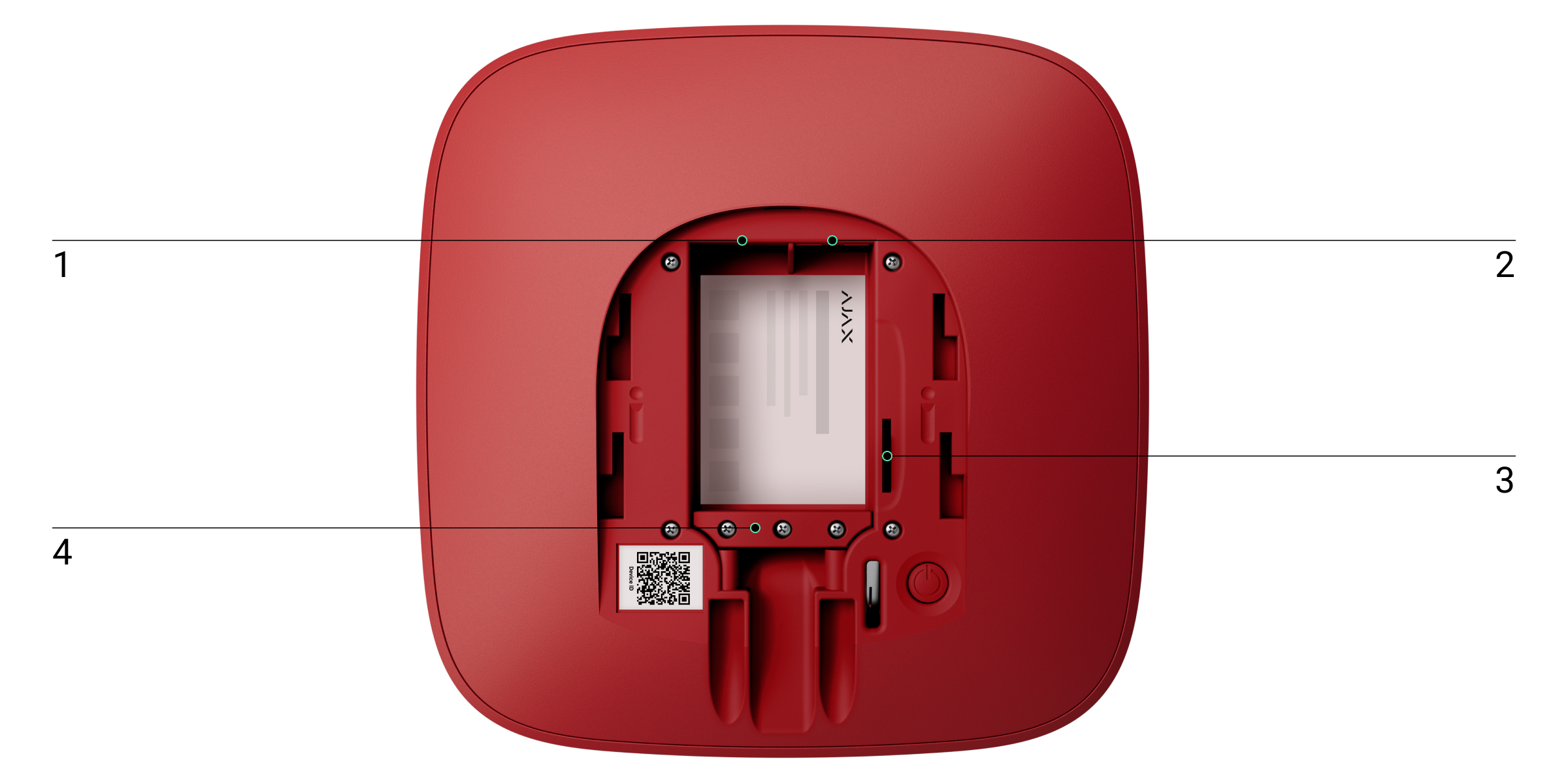
1 — Power cable socket.
2 — Ethernet cable socket.
3 — Slot for the micro SIM.
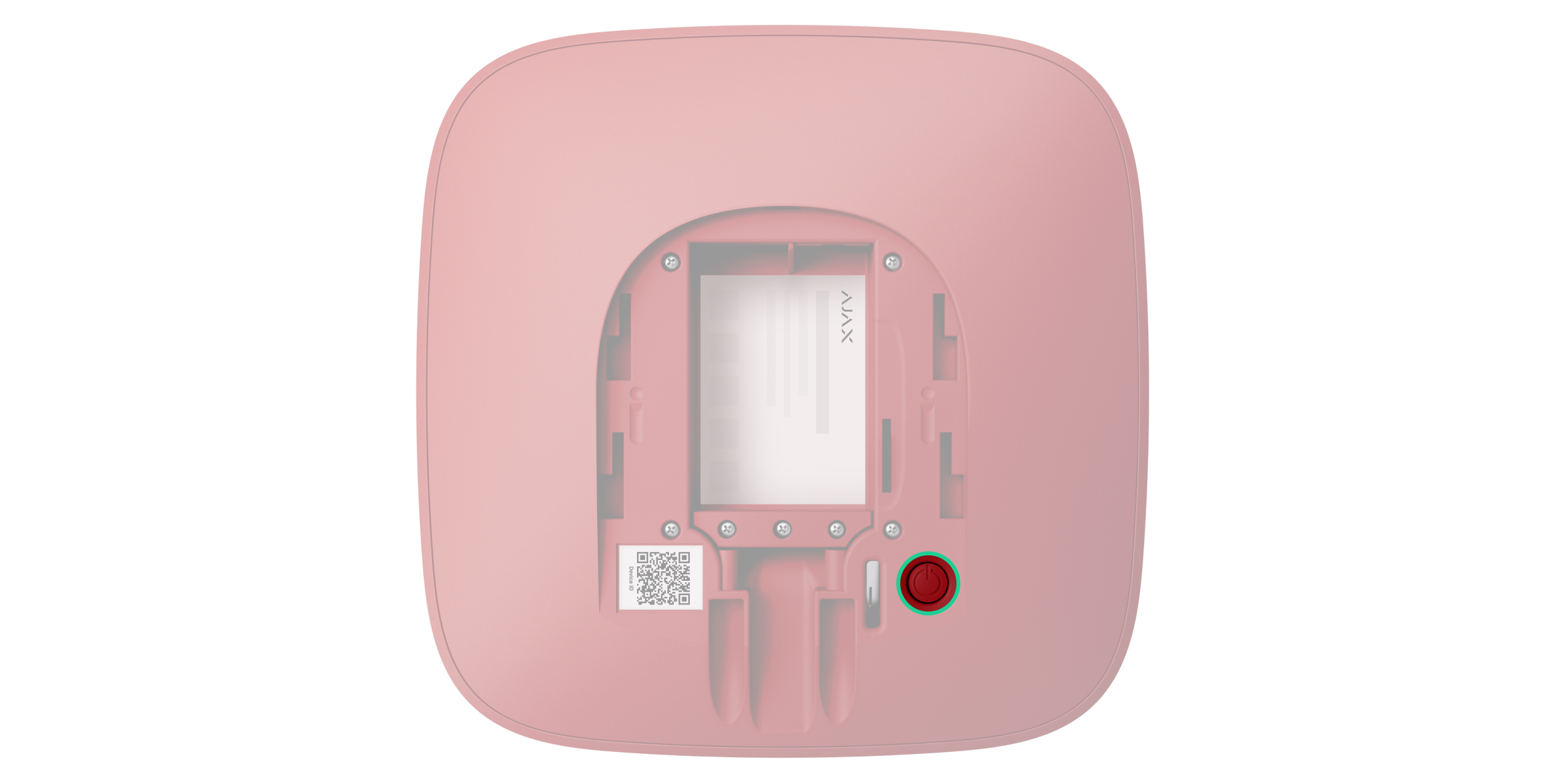
4 — Cable retainer clamp. - Press and hold the power button for 2 seconds until the logo lights up. The central unit needs approximately 2 minutes to identify the available communication channels.

The bright green or white logo color indicates that the central unit is connected to Ajax Cloud.
If the Ethernet connection fails
If the Ethernet connection is not established, disable proxy and MAC address filtering and activate DHCP in the router settings. The central unit will automatically receive an IP address. After that, you can assign a static IP address to the central unit in an Ajax app.
If the SIM connection fails
Type4 Hub (4G) Jeweller is sold with the Ajax SIM card or a third-party SIM card.
To connect to the cellular network, you need to install a micro SIM card with a PIN code request disabled and sufficient funds on your account to pay for services according to the tariff plan. To disable the PIN code request, insert the SIM card into your phone.
If the central unit fails to connect to the cellular network, use Ethernet to configure the network parameters, such as roaming, APN access point, username, and password. To obtain these parameters, contact the support service of your mobile operator.
Adding to the system
Use the latest versions of Ajax apps to access all available features and ensure proper system operation.
You can add the central unit to an existing space or create a new one. If you need to transfer the system from one central unit to another, refer to this article.
Before adding the central unit
- Install the Ajax PRO app.
- Log in to your PRO account or create a new one.
- Ensure an external power supply, Ethernet cable, and a SIM card are connected to the central unit.
- Ensure the central unit is turned on. If not, turn on the central unit by holding the power button for 3 seconds. Once the central unit is turned on, the LED indicator on the central unit board will light up.
Adding the central unit with space creation
- Open the Ajax PRO app.
- Go to the menu with all spaces and tap
 in the upper right corner to create a space.
 - Assign a name to the space and add an image if necessary.
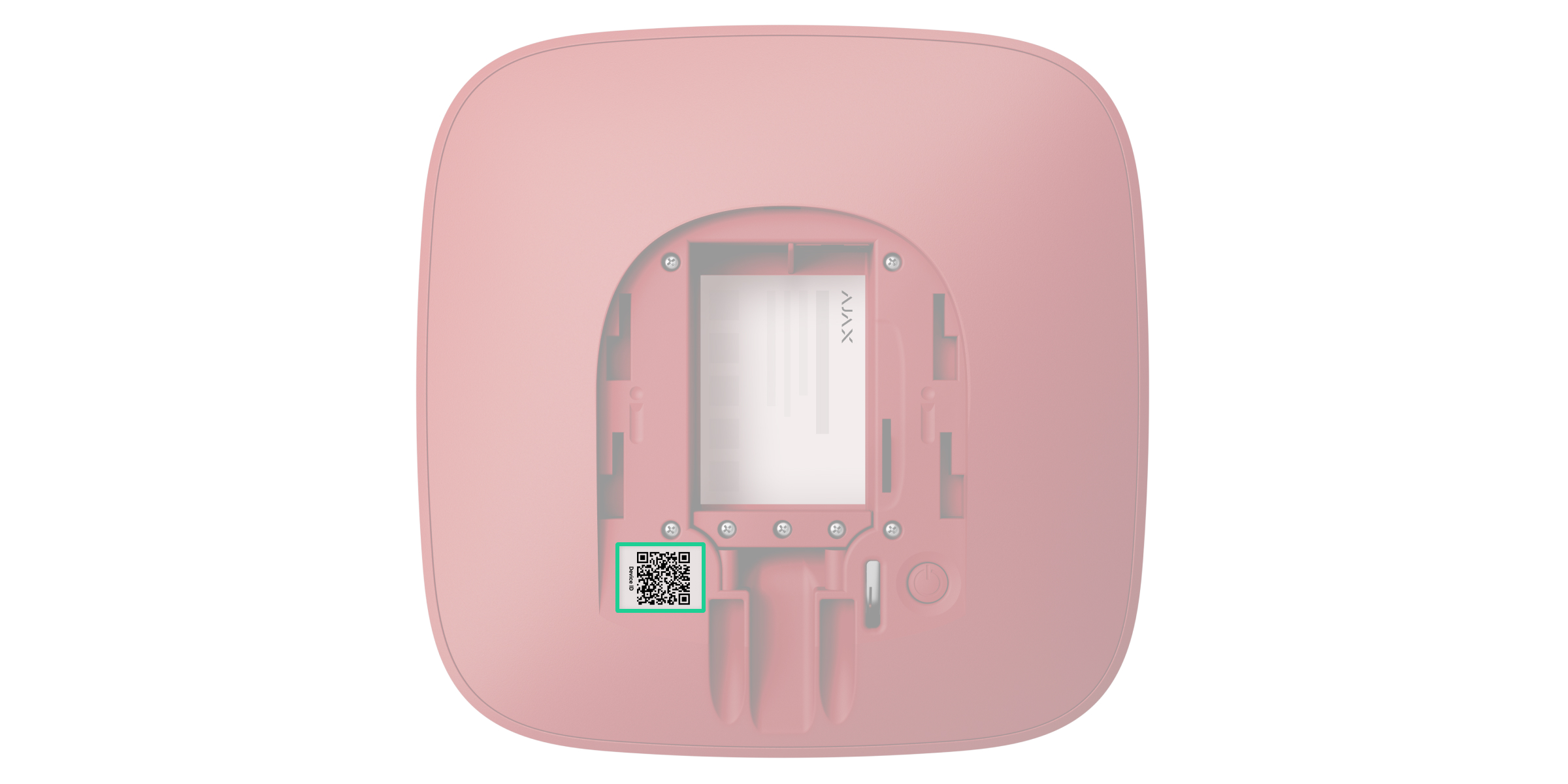
- Scan the QR code or enter the central unit ID manually. You can find the QR code with the ID on the central unit board. Also, it is duplicated on the central unit packaging.
- Tap Add to create the space with the central unit.
Adding the central unit to an existing space
- Open the Ajax PRO app. Select a space to which you want to add the central unit.
- Go to the Devices tab and tap Add device.
- Scan the QR code or enter the central unit ID manually. You can find the QR code with the ID on the central unit board. Also, it is duplicated on the central unit packaging.
- Assign a name to the central unit.
- Select a virtual room or create one if no rooms have been created yet.
- Tap Add, and the countdown will begin.
Once the central unit is added to your account, you become the central unit admin. Admins can invite other users to the system and determine their rights. You can add up to 50 users to Type4 Hub (4G) Jeweller.
Each PRO account added to the central unit, as well as the monitoring company profile, is considered a system user.
Changing or removing the admin from the list of central unit users does not reset the system settings or connected devices.

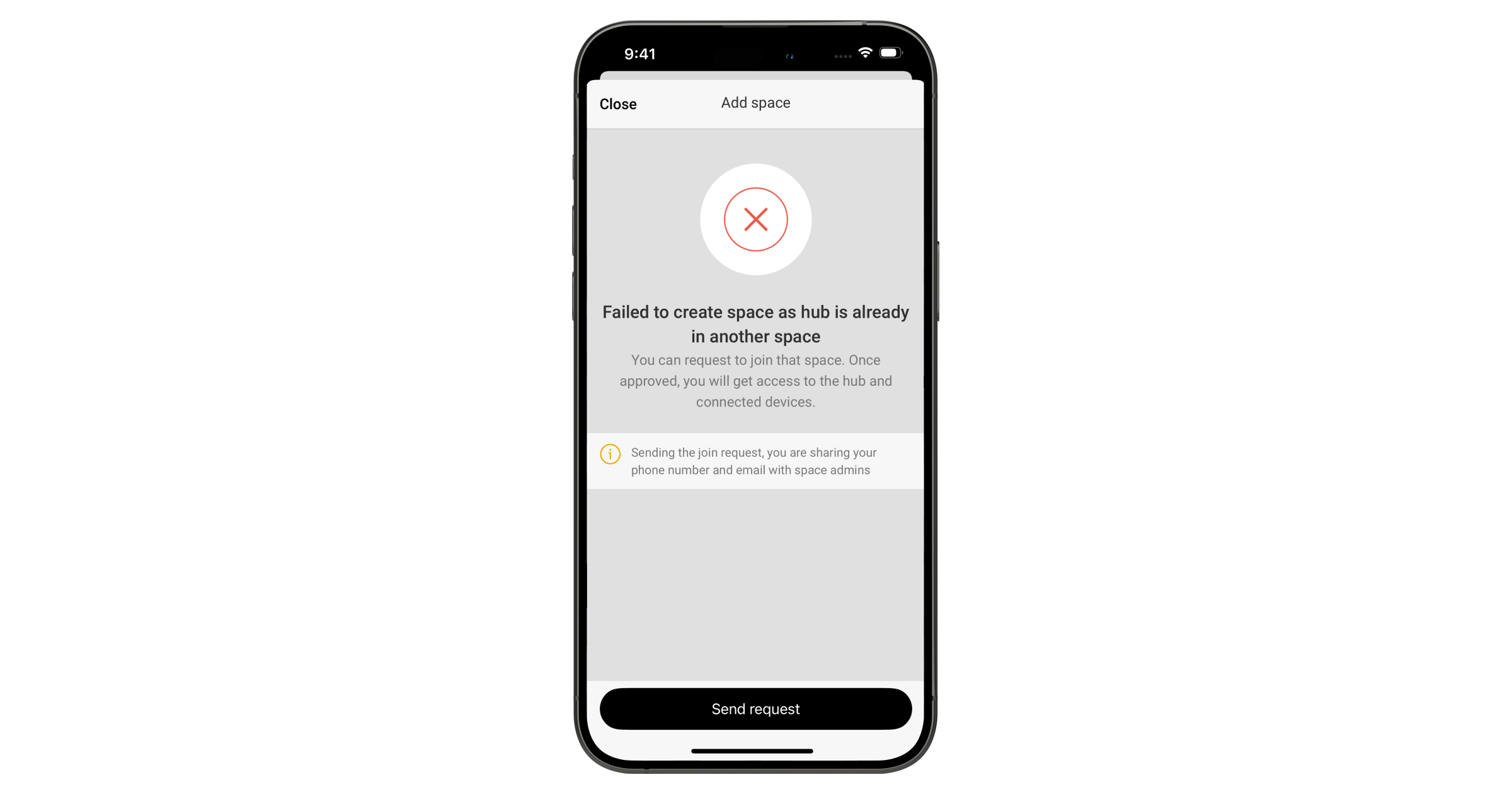
If there are already users on the central unit, the central unit admin, PRO with the rights to configure the system, or the installation company maintaining the selected central unit can add your account. You will be notified that the central unit has already been added to another account. Contact our technical support to determine who has admin rights on the central unit.
Adding devices to the central unit
Create the necessary virtual rooms before adding devices to the system. The rooms are needed to group devices and increase the information content of notifications. Device and room names are displayed in the text of Ajax system events and alarms.
For more information on how to add and configure a device, refer to its user manual, which can be found on the Ajax Support page.
To add a device to the central unit, in the Ajax PRO app:
- Go to the Devices tab and tap Add device.
- Scan the QR code or enter the device ID manually. You can find the QR code with the ID on the device enclosure. Also, it is duplicated on the device packaging.
- Assign a name to the device.
- Select a virtual room.
- Tap Add, and the countdown will begin.
- Follow the instructions in the app to add the device.
- Repeat steps 1–6 if you need to add more devices.
The device can be added to the central unit if it is located within the central unit’s radio communication range, on the same secure premises.
Once added to the central unit, the device will appear in the list of central unit devices in an Ajax app. The interval for updating device states in the list depends on the Jeweller settings and is 36 seconds by default.
Faults
If a central unit fault is detected (e.g., no external power supply is available), a fault counter is displayed on the device icon in an Ajax app.
All faults can be viewed in the central unit states. Fields with faults will be highlighted in red.
Icons
Icons display some of the Type4 Hub (4G) Jeweller states. The icons are displayed in the Devices tab in an Ajax app.
| Icon | Meaning |
 |
The extra services are activated according to the subscription plan. |
 |
The SIM card is not installed. |
 |
The SIM card faulty or has a PIN code set up. Check SIM card operation in the phone and disable the PIN code request. |
 |
Battery charge level of the central unit. |
 |
The backup battery is not connected. |
 |
The central unit fault is detected. The list is available in the central unit states menu. |
 |
Some devices added to the hub are disabled. |
 |
The fire is detected. |
 |
The central unit is directly connected to the monitoring station of the security company. The icon is not displayed if direct connection is not available or not configured. |
 |
The central unit is not directly connected to the monitoring station of the security company. The icon is not displayed if direct connection is not available or not configured. |
 |
Firmware update is in progress: downloading/installing the latest version. |
 |
The central unit operates in Saving mode. |
 |
The central unit has lost connection with the Ajax Cloud server. |
States
The states include information about the central unit and its operating parameters. The Type4 Hub (4G) Jeweller states can be viewed in Ajax apps:
- Go to the Devices tab.
- Select Type4 Hub (4G) Jeweller from the list.
| Parameter | Meaning |
| Alarm |
Tap The field is displayed only if a fire is detected. |
| Fault |
Tap The field is displayed only if a fault is detected. |
| System restore required | The field appears only if the appropriate option is enabled, and some alarms and/or faults should be fixed before arming. |
| Cellular signal strength |
The signal strength of the active SIM mobile network. Install the central unit in places where the cellular communication level reaches 2–3 bars. If the central unit is installed in a place with weak or unstable signal strength, it will not be able to call or send an SMS about an event or alarm. |
| Connection | Connection state between the central unit and Ajax Cloud:
If Type4 Hub (4G) Jeweller is not connected to the Ajax Cloud server, the central unit and all connected device icons become semi-transparent in the device list. |
| Battery charge | The backup battery charge level is displayed as a percentage or one of the following states:
If charge level is 20% or below, the system will notify users of a low battery charge. |
| Lid | The state of the tamper button that responds to detachment or opening of the device enclosure:
|
| Main power | External power supply connection state:
|
| Cellular data | Mobile Internet connection status of the device:
If the cellular signal strength reaches 1–3 bars, and the central unit has enough funds and/or has bonus SMS/calls, it will be able to call and send SMS, even if this field displays the Not connected state. |
| Ethernet | Internet connection state of the central unit via Ethernet:
|
| SIM 1 |
The number of the SIM card installed in the first slot. To copy the number, click on it. If the phone number is displayed as an Unknown number, the operator has not written it to the memory of the SIM card. |
| Average noise |
Average noise in the radio channel. Measured in the place where the central unit is installed. The first two values show the level at Jeweller frequencies, and the third — at Wings frequencies. The acceptable value is –80 dBm or lower. For example, –95 dBm is considered acceptable and –70 dBm is invalid. |
| Monitoring station | State of the central unit’s direct connection to the monitoring station:
If this field is displayed, the monitoring company uses a direct connection to receive system alarms and events. |
| Hub model | Central unit model name. |
| Hardware | Device hardware version. Not updated. |
| Firmware |
Device firmware version. Updates remotely. |
| Device ID |
Identifier (first 8 digits of the serial number) of the device. The identifier is located on the device box and on the board under the QR code. |
| IMEI | A unique 15-digit serial number for identifying the central unit modem on a GSM network. It is shown only when a SIM card is installed in the central unit. |
 to open detailed information about the fire location.
Settings
To change Type4 Hub (4G) Jeweller settings, in an Ajax app:
- Go to the Devices tab.
- Select Type4 Hub (4G) Jeweller from the list.
- Go to Settings
 .
. - Set the required parameters.
- Tap Back to save the new settings.
Name
The central unit name is displayed in the SMS and push notification text. The name can contain up to 24 Latin characters or up 12 Cyrillic characters.
To change the name, tap on the pencil icon  and enter the new central unit name.
Room
Selecting a virtual room to which the central unit is assigned. The room name is displayed in the SMS and push notification text.
Fire system settings
Configuring system settings in case of a fire alarm:
Alarm signal
Configure the alarm sound for fire and non-fire alarms, and set the duration for the latter.
Test alarm
Output activation time — set how long outputs stay active in response to test alarm. Applies to sounders, visual alarm devices, and I/O module relays that activate during a zone test.
Ethernet
Settings for a wired internet connection.
- Connection via Ethernet — allows turning on/off the central unit’s Ethernet module.
- Connection type — allows selecting the method for the central unit to obtain an IP address. If DHCP is selected, the central unit automatically obtains its IP address and other network settings. The Static option allows you to manually set the IP address and other network settings for the central unit.
- IP address — the central unit IP address.
- Subnet mask — the subnet mask in which the central unit operates.
- Gateway — the gateway used by the central unit.
- DNS — the central unit DNS.
Cellular
Settings for the mobile network and the installed SIM card.
Modem settings
- Cellular data — allows turning on/off the central unit’s cellular module.
- Roaming — if this setting is enabled, the SIM card can operate in roaming mode.
- Ignore network registration error — if this setting is enabled, the central unit ignores errors when connecting to the network via a SIM card. Enable this setting if the SIM card cannot connect to the network.
- Disable communication check with the operator — if this setting is enabled, the central unit ignores errors when connecting to the mobile operator. Enable this setting if the SIM card cannot connect to the network.
SIM card settings
APN, Username, and Password — settings for connecting the central unit to the internet via a SIM card. To obtain the settings of your mobile operator, contact your provider’s support service. APN settings are applied only after a successful internet connection with new parameters is established. If the connection attempt fails, the central unit continues to work with the previous APN settings.
Mobile data usage. The menu contains information about mobile traffic used by an Ajax system, allowing you to reset the statistics and check the SIM card balance.
The data is calculated by the central unit and may differ from the operator’s statistics. This is because each mobile operator calculates incoming and outgoing traffic individually.
- Incoming — the amount of data received by the central unit. Displayed in KB or MB.
- Outgoing — the amount of data sent by the central unit. Displayed in KB or MB.
Reset statistics — allows resetting the statistics for incoming and outgoing traffic.
Check balance
USSD code. Enter the code used to check the balance in this field. For example, *111#. To send a request, tap Check balance after entering the code. The request result will be displayed under the balance check button.
Jeweller
Setting the polling period between the central unit and connected devices. The setting indicates how often the central unit communicates with the devices and how quickly a connection loss is detected.
- Device ping interval, sec — the frequency of polling connected devices by the central unit; set in the range from 12 to 300 seconds. The default value is 36 seconds.
- Number of missed pings to determine connection failure — a counter of undelivered packets. The default value is eight packets.
Do not reduce the default polling interval value unnecessarily.
The time after which the system sends a message about a connection loss between the central unit and the device is calculated with the following formula:
Device polling interval × Number of missed polls to determine connection failure
The shorter the polling period, the faster the central unit will know about the connected device events, and the faster the devices will receive central unit commands. Information about alarms and sabotage attempts is transmitted instantly, regardless of the polling interval. Reducing the polling period will affect the battery life of devices.
The polling interval limits the maximum number of connected devices:
| Interval | Device limit |
| 12 s | 39 devices |
| 24 s | 79 devices |
| 36 s and more | 100 devices |
Send alarm when connected device goes offline — when enabled, events about connection loss are sent as alarms to all system users.
Fire alarm response time — defines how quickly notification devices are activated after a fire alarm is detected. There are two options:
- Fast response — time from alarm detection to device activation is up to 3 s for sounders and up to 10 s for visual alarm devices.
- Standard response — time from alarm detection to device activation is up to 6 s for sounders and up to 13 s for visual alarm devices.
Telephony settings
This setting is only available in Ajax PRO apps.
Telephony settings allow configuring the central unit to communicate with the monitoring station via the SIP protocol.
In Ajax PRO Desktop, you can create and apply a telephony setting template to save time when configuring multiple systems.
Service
The central unit service settings are divided into two groups: general settings and advanced settings.
General settings
LED brightness
This setting allows configuring the central unit’s LED indicator brightness.
Firmware update
The menu contains the central unit firmware update settings.
Check for new version allows manually checking and installing firmware updates when they are available or assigned to the central unit. This option is available only when the Firmware auto-update setting is enabled.
If the central unit firmware is outdated, an error may occur when you add a device to the central unit. In this case, the system will prompt you to open the Firmware update section in the Service settings and check for a new firmware version. If it is available, you can proceed with an on-demand firmware update.
Hub system logging
This setting allows selecting the central unit log transmission channel or disabling log recording:
- Off — logging is disabled.
- Ethernet — system logs are transmitted via the Ethernet channel.
- Cellular for 10 minutes — note that the cellular logging significantly increases mobile data usage.
Logs are files containing information about system operation. Do not disable the logs, as this information may be helpful in case of system errors.
Delaying notifications of external power loss
This setting allows configuring a delay time for sending an external power loss notification.
You can select the delay time from 1 minute to 1 hour in 1-minute increments.
“While hub offline” event amount
In case of server connection failure, events are recorded in the central unit buffer and will be delivered to Ajax apps once the connection is restored.
This setting allows choosing the number of recent events that the central unit will send to Ajax apps after returning to normal operation.
You can select from 100 (default value) to 1,000 events with an increment of 50 events.
Advanced settings
Server connection
These settings allow configuring the connection between the central unit and the Ajax Cloud server:
- Delay of server connection failure alarm. The delay is necessary to reduce the risk of false notifications of a connection loss with the Ajax Cloud server. It is activated after three unsuccessful central unit–server polls. The delay can be set in the range from 30 to 600 s. The recommended default value is 300 s.
- Hub-server polling interval, sec. Indicates the frequency of polling requests from the central unit to the Ajax Cloud server. It can be set in the range from 10 to 300 s. The recommended default value is 60 s.
The time before the central unit sends a notification of a connection loss with the Ajax Cloud server is calculated with the following formula:
(Polling interval × 3) + Time filter.
With the default settings, Ajax Cloud detects a connection loss with the central unit within 8 minutes:
(60 s * 3) + 300 s = 8 min.
- Get notified of server connection loss without alarm. Ajax apps can notify users of a connection loss between the central unit and the server in two ways: with a standard push notification or with a siren sound (enabled by default). When the option is active, the notification comes as a standard push.
- Notify of connection loss over channels. An Ajax system can notify both users and the monitoring company of a connection loss between the central unit and the Ajax Cloud server even via one of the communication channels.
In the menu, you can select the communication channels through which the system will notify users of a connection loss, as well as the transmission delay for such notifications.
- Loss notification delay — the delay time before the system sends a connection loss notification via one of the communication channels. The delay can be set in the range from 3 to 30 minutes.
The time for the system to send a connection loss notification via one of the communication channels is calculated with the following formula:
(Polling interval × 3) + Time filter + Notification delay.
User manual
If you tap this option, the Type4 Hub (4G) Jeweller user manual will open in an Ajax app.
Transfer settings to another central unit
This option allows for automatic transfer of the devices and settings to another central unit. Note that you are in the settings of the central unit from which you want to export data.
Remove hub
This option allows you to remove the central unit and devices added to it from the space. While space remain active, central unit and connected devices will be deleted from it. Other users on this space also lose access to these devices.
Space settings
In the space settings, you can configure the following:
- Image and name
- Address
- Users
- Privacy
- Geofence
- Groups
- Video scenarios
- Time zone
- Security companies
- Installers/Companies
You can change space settings in an Ajax app:
- Select a space if you have several or if you are using the Ajax PRO app.
- Go to the Control
 tab.
tab. - Go to Settings by tapping the gear icon at the bottom of the tab.
- Set the required parameters.
- Tap Back to save the new settings.
Selecting the installation site
When choosing where to place Type4 Hub (4G) Jeweller, consider the parameters that affect its operation:
- Jeweller signal strength.
- The distance between the fire alarm central unit and devices.
Install the central unit on a vertical surface. This will ensure proper tamper button response if someone attempts to remove the device.
Choose a location where the central unit can access all available communication channels: Ethernet and a SIM card. Ensure that the cellular signal at the installation site is stable and reaches at least 2–3 bars. Correct device operation is not guaranteed if the cellular signal is weak.
When selecting the installation site, consider the distance between the central unit and devices, as well as any obstacles that may interfere with radio signal transmission, such as walls, intermediate floors, or large objects in the room.
To roughly calculate the signal strength at the place of installation of devices, use our radio communication range calculator. Note that if the signal strength is excellent, the device can automatically adjust the power of radio transmission to reduce power consumption and radio interference.
Run the Jeweller signal strength test before final installation. The test checks the signal strength at the device’s maximum transmission power. To comply with Type4 requirements, the signal strength between the device and the central unit must be at least two bars. With a signal strength of one or zero bars during the test, we do not guarantee stable operation of the system.
If the system has devices with signal strength of 1 or 0 bars, consider relocating the central unit or device. If this is not possible or the device still has low or unstable signal strength after being moved, use Type4 ReX Jeweller.
Where not to install the device
- Outdoors. This could result in device failure.
- Near metal objects and mirrors. They can cause attenuation or shielding of the radio signal. This could result in the loss of connection between the central unit and Ajax devices.
- In places with high levels of radio interference. This could result in the loss of connection between the central unit and Ajax devices or false notifications about security system jamming.
- Less than 1 meter away from the router and power cables. This could result in the loss of connection between the central unit and devices.
- Less than 1 meter away from Jeweller devices. This could result in the loss of connection between the central unit and these devices.
- In places where the central unit will have a signal strength of 1 or 0 bars with connected devices. This could result in the loss of connection between the central unit and these devices.
- Inside premises with temperature and humidity beyond the permissible limits. This could result in a failure of the central unit.
- In places with no cellular signal or 1 bar signal strength. We do not guarantee the correct operation of the device with a low cellular signal strength.
Installation
During installation and operation of the Ajax system, adhere to the rules and requirements of regulatory legal acts on electrical safety. Do not disassemble the device while it is energized or use it with a damaged power cable. Observe the safety procedures and the rules for electrical installation work when connecting the central unit.
Before installing Type4 Hub (4G) Jeweller make sure that you have selected the optimal location and that it meets the requirements of this manual.
To install Type4 Hub (4G) Jeweller:
- Slide the SmartBracket mounting panel down to remove it from the central unit.
- Connect the power cable to the device’s power supply connector.
- Connect the Ethernet cable to the device’s Ethernet cable connector.
- Secure the power and Ethernet cables with the supplied cable retainer clamp and screws. The cable retainer clamp must fit tightly to the cable so that the device lid closes easily. This will reduce the likelihood of sabotage, as it takes a lot more to tear away a secured cable.
- Add the central unit to the system.
- Temporarily secure the SmartBracket panel using double-sided adhesive tape or other temporary fasteners.
Use the central unit with H.T4.J-000-EU SmartBracket mounting panel only.
Double-sided adhesive tape should only be used for temporary installation. The device attached with the tape may come unstuck at any time. As long as the device is secured with the double-sided adhesive tape, the tamper button will not be triggered when the device is detached from the surface.
- Place the central unit on the SmartBracket mounting panel.
- Perform the functionality testing.
- If the test is successful, remove the device from SmartBracket.
- Secure the SmartBracket panel to the surface with bundled screws. Use all fixing points.
If you use other fasteners, ensure they do not damage or deform the panel.
- Place the device on the SmartBracket mounting panel.
- Tighten the holding screws on the bottom of the device enclosure. The screws are needed for more reliable fastening and to protect the device from quick dismantling.
Indication
The central unit’s LED lights up in different colors depending on the system state or event, such as red, white, purple, yellow, blue, or green.
Type4 Hub (4G) Jeweller states can also be monitored in Ajax apps.
| Event | Indication | Note |
| Two communication channels are connected: Ethernet and cellular. | Lights up white. | When the central unit operates on a backup battery only, the LED indicator flashes every 10 seconds. |
|
One communication channel is connected: Ethernet or cellular. |
Lights up green. | When the central unit operates on a backup battery only, the LED indicator flashes every 10 seconds. |
| The central unit has no connection to the internet or the Ajax Cloud server. | Lights up red. | When the central unit operates on a backup battery only, the LED indicator flashes every 10 seconds. |
| External power supply is disconnected (if a backup battery is connected). | Lights up continuously for 3 minutes, then flashes every 10 seconds. | The indication color depends on the number of connected communication channels. |
| The central unit is reset to factory settings. | Flashes red. |
If the system event indication differs from that specified in this user manual, contact Ajax support.
Resetting to factory defaults
To reset the central unit to factory defaults:
- Turn on the central unit if it is off.
- Remove all users and installers from the central unit.
- Hold the power button for 30 seconds, and the LED indicator on the central unit board will start flashing red.
- Remove the central unit from your account.
All the connected detectors, room settings, and user settings will be deleted. User profiles will remain connected to the system.
Maintenance
Regularly check the operation of Type4 Hub (4G) Jeweller and connected devices. The optimal frequency of checks is once every three months. Clean the central unit casing of dust, cobwebs, and other contaminants as they appear. Use a soft, dry cloth suitable for equipment care.
Do not use substances containing alcohol, acetone, petrol, or other active solvents to clean the device.
If the central unit battery becomes faulty, and you need to replace it, use the following guidance:
Warranty
Warranty for the Limited Liability Company “Ajax Systems Manufacturing” products is valid for 2 years after the purchase.
If the device does not operate properly, we recommend contacting Ajax technical support first. In most cases, technical issues can be resolved remotely.
Contact technical support:
Manufactured by “AS Manufacturing” LLC