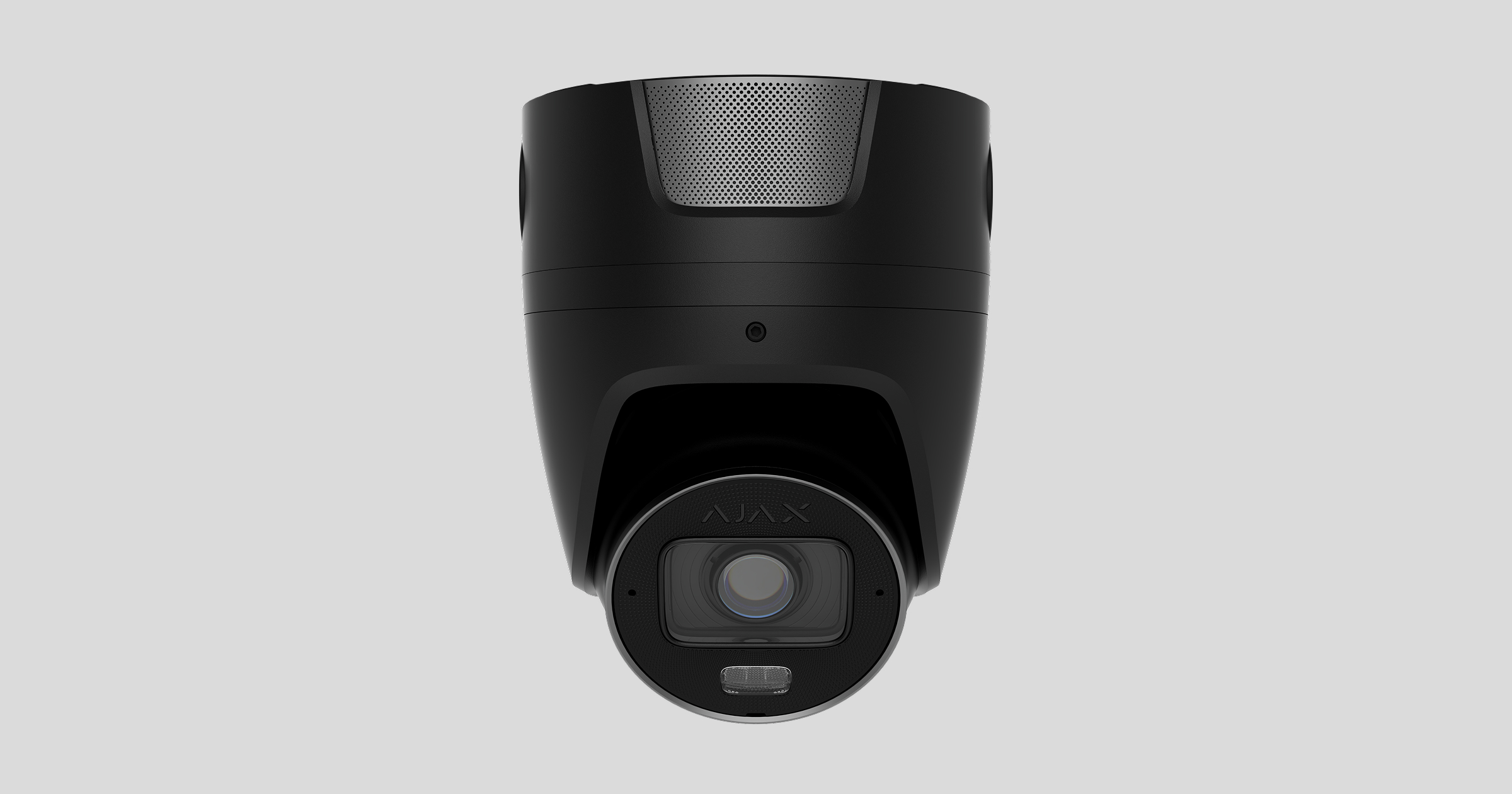
Superior TurretCam HLVF is a wired AI-powered security IP camera with a 2.8–12 mm motorized varifocal P-Iris lens that provides clear and detailed images at any focal length. The camera supports the True WDR technology for accurate color reproduction in scenes with high-contrast lighting. Also, the device features hybrid illumination that combines infrared (IR) and white light to enhance nighttime visibility.
The built-in microphones and speaker provide two-way audio, while audio and alarm inputs/outputs expand integration capabilities with other security devices. The camera supports PoE and 12 V⎓ power supply options.
Superior TurretCam HLVF is connected to the system via Ethernet. The recorded videos can be stored on an Ajax NVR added to the same network or on a memory card installed in the camera.
The camera is available in several versions:
- Superior TurretCam HLVF (4 Mp);
- Superior TurretCam HLVF (8 Mp).

Camera versions with other enclosures are also available. All Ajax cameras are available here.
Functional elements
- Speaker.
- Junction box.
- Holder.
- Enclosure.
- Lens.
- White LED indicators. When motion is detected, the camera instantly turns on white light to bring out the object’s colors.
- Screw for securing the camera enclosure in the holder. Can be unscrewed with a bundled hexagon key (Ø 2.5 mm).
- Microphones.
- Cable gland plug. Remove the plug to run the wires.
- Ethernet connector.
- Holes for attaching the enclosure to the junction box.
- Connector plate.
- Alarm input/output connector.
- Power connector.
- Audio input/output connector.
- Holes for attaching the junction box to a surface.
- Reset button.
- Slot for microSD card.
Operating principle
Superior TurretCam HLVF is an IP camera that uses artificial intelligence (AI) to analyze video frames and recognize object types. The camera can distinguish between people, animals, and vehicles.
The camera is equipped with a 2.8–12 mm motorized varifocal P-Iris lens that allows remote adjustment of the focal length and optimal lighting control. Motorized zoom and focus enable precise framing of the protected area without physical access to the camera. The P-Iris mechanism automatically adjusts the aperture to maintain sharpness and balanced brightness in all lighting conditions.
The device features hybrid illumination, combining infrared and white light to ensure high-quality images in any lighting conditions. Superior TurretCam HLVF automatically switches between IR and white light depending on the scene, delivering clear black-and-white images in low light and providing color photos when motion is detected or additional illumination is required. The camera also adjusts the light intensity in real time to prevent overexposure, ensuring clear visibility of both near and distant objects.
The built-in microphones and speaker provide two-way audio, enabling users to listen and communicate through the camera. The audio and alarm inputs/outputs expand integration capabilities with third-party devices.
To save the recorded videos, you need to add Superior TurretCam HLVF to an Ajax NVR or install a microSD card with a memory capacity from 32 GB to 256 GB (not included in the complete set of the camera).
Using the video storage calculator, you can calculate the NVR or camera required storage capacity and estimated recording time based on the video stream settings.
Superior TurretCam HLVF enables you to:
- Watch the video in real time with the ability to zoom in for a closer look.
- Remotely adjust the zoom and focus using the motorized varifocal lens for optimal framing of the monitored area.
- Communicate with visitors using the camera’s microphones and speaker.
- Access archived videos, navigating through them based on recording chronology and the calendar (this feature is available if the device is connected to an Ajax NVR or the cloud archive is activated).
- Configure movement detection zones and adjust the sensitivity level.
- View the Video wall, which combines images from all connected cameras.
- Quickly access automation device control from the cameras’ video player menu.
- Use two-way audio: communicate through the built-in microphones and speaker, or use an external speaker connected via the audio output.
- Integrate external devices via alarm input and output terminals to cover various security and automation scenarios.
- Create video scenarios that send a short video from the selected camera to an Ajax app when the security detector is triggered.
- Download the required segments of video recordings from the archive to smartphones or PCs (this feature is available if a microSD memory card is installed in the camera, or it is connected to NVR with an installed hard disk).
The video recording segments downloaded from Superior TurretCam HLVF have the Ajax digital signature that verifies the integrity of the exported video. To verify the authenticity of the downloaded video recordings, use the Ajax Media Player tool.
- Configure connection via ONVIF to integrate the device with video management systems (VMS) such as Milestone, Genetec, Axxon, and Digifort.
Video scenarios
An Ajax system allows the use of IP cameras for alarm verification. Video scenarios enable the substantiation of alarm triggers with the corresponding video from cameras installed at the facility.
Cameras can be configured to respond to alarms from a single device, multiple devices, or all connected devices. Combined detectors can register various types of alarms, allowing you to configure responses to a wide range of alarm types, whether it’s just one, several, or all of them.
You can also configure the sirens to activate when motion or a specific AI-recognised object is detected. When video devices detect motion or a specific AI-recognised object, the system automatically activates sirens added to the hub to sound an alarm.
Video wall in Ajax apps
The user can manage videos on the Video wall  tab, which is accessible once at least one camera has been added. This feature ensures quick access to all connected cameras, which are displayed in accordance with privacy settings.
In mobile Ajax apps, you can:
- Control the camera’s zoom and focus.
- Switch between cameras.
- View recorded footage together with other cameras.
- Search for the desired camera by name.
- Manage a PTZ camera.
In desktop Ajax apps, you can:
- Control the camera’s zoom and focus.
- Switch between cameras.
- View recorded footage together with other cameras.
- Search for the desired camera by name.
- Organize cameras by room, NVR, or group.
- Manage a PTZ camera.
- Save customized layouts for displaying video from cameras.
- Change the order in which the camera video is displayed.
- Create templates for displaying videos in a slideshow.
Privacy zones
The system allows hiding parts of the frame. For instance, if a sensitive area or object is in view, activity around it can be recorded without revealing its contents by setting up the right zone. No motion or object will be detected and recorded in the privacy zone.
To do this, in Ajax apps:
- Go to the Devices
 tab.
tab. - Select the camera from the list. If it is connected to the network video recorder, find NVR and tap on Cameras.
- Go to the device states by tapping the gear icon
 .
. - Tap the gear icon again to open Settings.
- Select the Privacy zones menu.
- Open the Configure privacy zones menu and select the required area.
- Tap on the
 icon and return to the camera settings.
The user can create up to four private zones.
Line crossing detection
Line crossing detection is a feature that enables video surveillance cameras to respond when a specified object — such as person, pet, or vehicle — crosses a virtual line drawn in the camera frame. When the line is crossed, the system can send a notification or an alarm and record the crossing footage in the archive.
To add a line in an Ajax app:
- Select the required space.
- Go to the Devices tab.
- Select the camera from the list. If it is connected to a network video recorder, find NVR and tap Cameras.
- Open the camera settings by tapping the gear icon twice.
- Go to the Detection menu.
- Open the Line crossing detection settings.
- Tap Add
 or in the upper-right corner.
 - In the menu that opens, configure the following:
- Set line crossing rule. Adjust the line position and crossing direction.
- Enter a name for the line in the Title field.
- Select the required triggers.
- Tap Save to add the line.
After adding a line, it is strongly recommended to test how the camera detects line crossings. For guidance on fine-tuning the line for accurate detection, refer to the Recommendations and best practices section.
You can add up to 4 lines per camera.
Firmware update
If a new firmware version for Superior TurretCam HLVF is available, the  icon appears in Ajax apps in the Devices tab. An admin or a PRO with access to the system settings can launch an update via device states or settings. The on-screen instructions help to update the firmware successfully.
Selecting the installation site
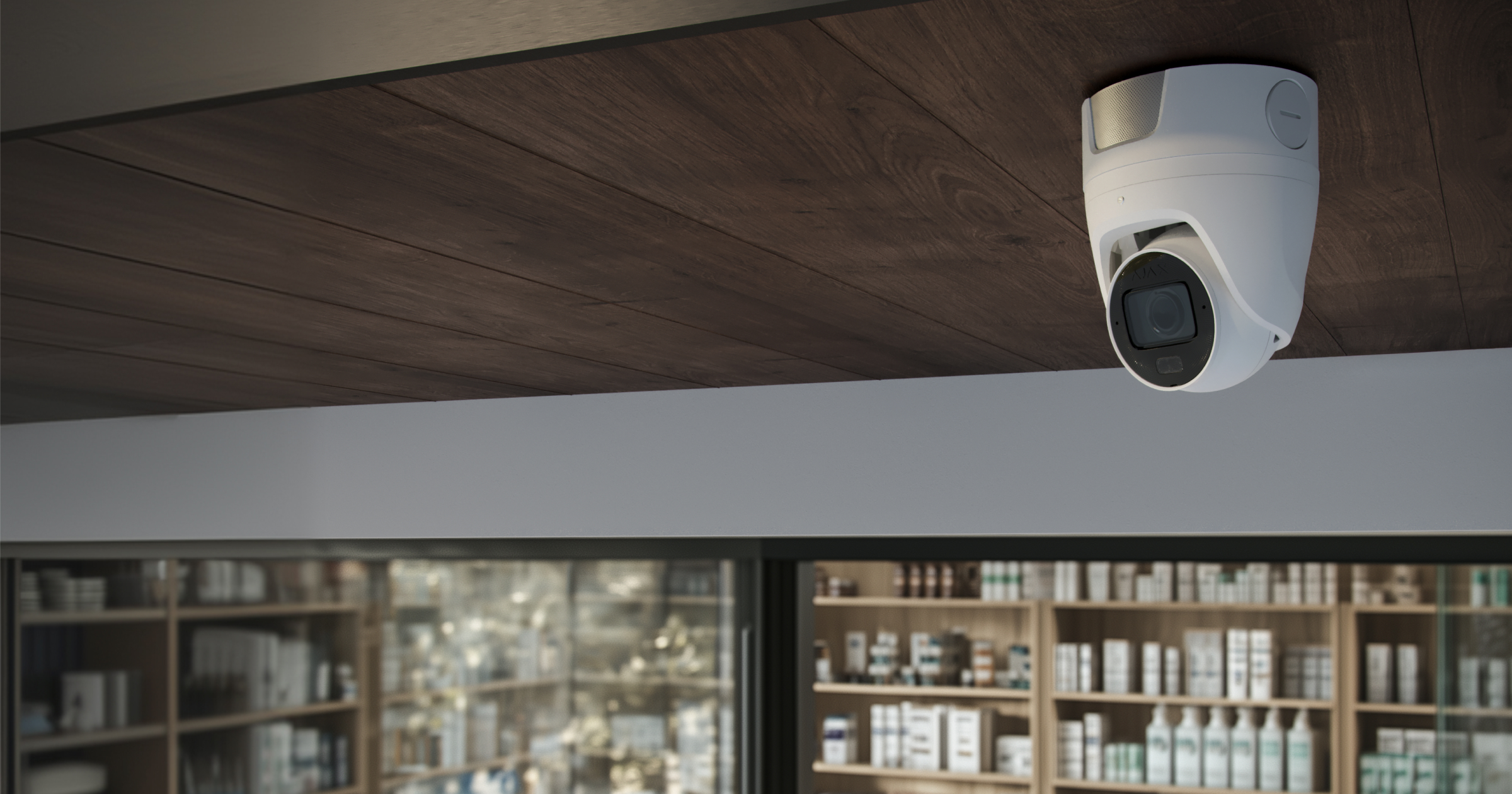
When choosing where to place Superior TurretCam HLVF, consider the presence of objects or structures that may obstruct the device’s view.
Consider the placement recommendations when developing a system project for the facility. Only professionals must design and install an Ajax system. A list of recommended partners is available here.
Where not to install the camera
- In places where the temperature and humidity exceed the permissible limits. This may damage the device.
- In places where objects or structures may obstruct the device’s view.
- In locations that are subject to constant vibration or have unstable mounting surfaces. This may affect the accuracy of motorized zoom and autofocus.
- Too close to reflective surfaces, such as walls or glass, where IR or white light may reflect into the lens, reducing image quality.
Installation

Before installing Superior TurretCam HLVF, ensure that you have chosen the optimal location that complies with the requirements of this manual.
When connecting an external power supply and using Superior TurretCam HLVF, follow the general electrical safety regulations for using electrical appliances, as well as the requirements of regulatory legal acts on electrical safety.
To install the device:
- Using the bundled hexagon key (Ø 2.5 mm), remove the screw and detach the camera enclosure from the holder with the junction box.
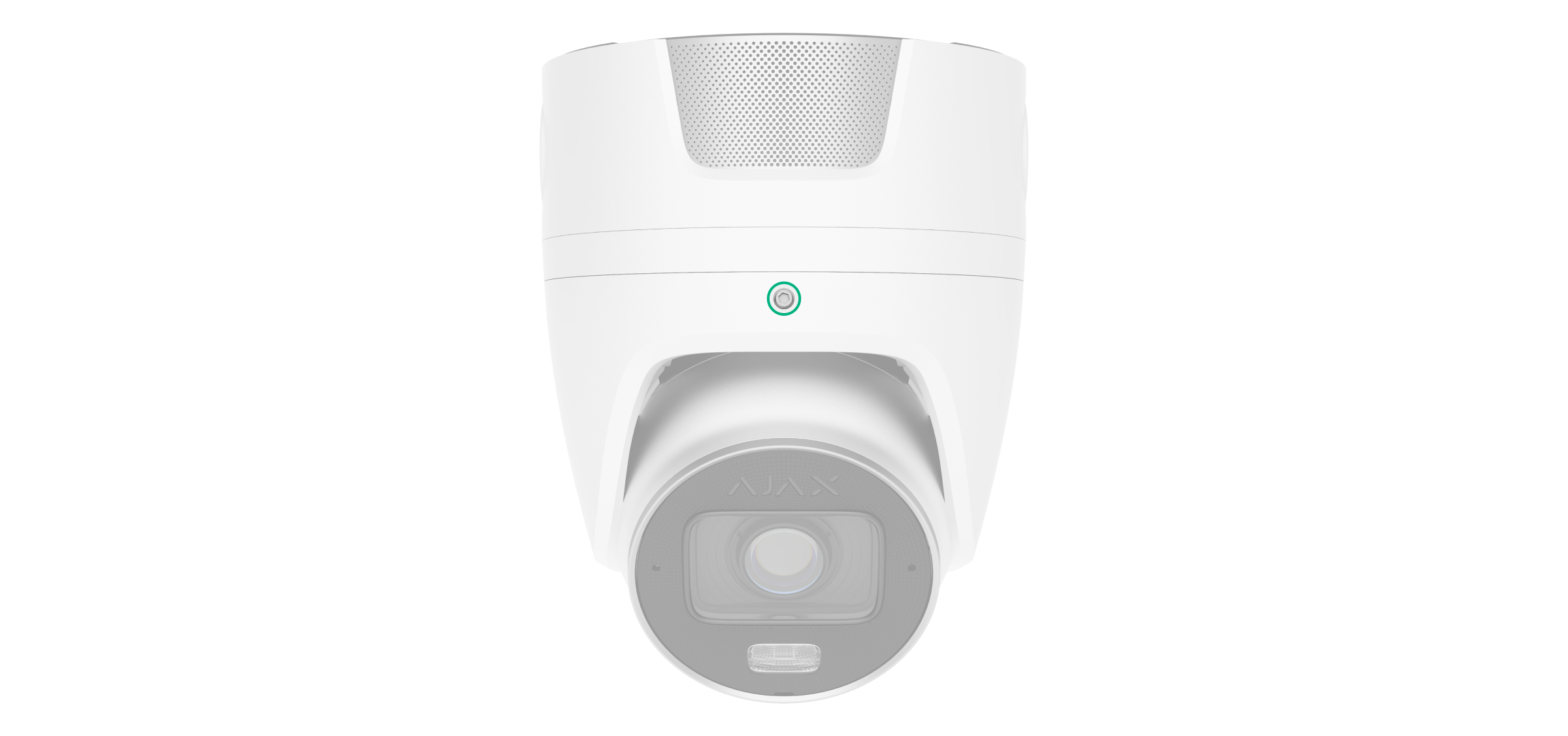
- Using the bundled hexagon key (Ø 2.5 mm), remove the screws securing the protective cover.

- Insert a microSD card (not included) into the appropriate slot. Tighten the screws securing the protective cover.
After adding the device to the system, format the memory card in the camera settings.

- Using the bundled hexagon key (Ø 2.5 mm), remove the screws securing the holder to the junction box. Remove the safety cable.

- Prepare the hole in the bottom or side of the junction box in advance: remove the cable gland plug and close the other hole.
- Use the installation template to mark the locations for drilling holes on the surface where you plan to mount the camera. Secure the template to the chosen installation location with tape and drill the holes as indicated on the template.
Before you start drilling, consider the camera’s orientation, the position of the built-in microphones and speaker, and potential obstacles.
- Route the cables through the camera’s junction box.
- Secure the junction box to a vertical or horizontal surface at the selected installation site with the bundled screws using all fixing points.
- If the camera is not powered by PoE, connect the power cable to the terminal block included in the complete set.
- If necessary, connect the alarm and audio cables to the terminal blocks included.
- Attach the holder to the junction box using the safety cable.
- Connect the Ethernet cable to the enclosure. If the camera is powered by PoE, no external power supply is required.
- Insert the terminal blocks into the corresponding slots.
- Route the cables inside the junction box.
- Install the holder on the junction box. Using the bundled hexagon key (Ø 2.5 mm), tighten the screw. Check that the holder is securely fastened.
- Install the enclosure on the holder.
- Turn on the camera’s power supply. When the network connection is established, the LED indicator on the cable connector lights up green.
- Add the camera to the system.
- Adjust the camera’s viewing angle by loosening the screw and rotating the camera enclosure. The focal length can be configured remotely in an Ajax app.
Adding to the system
Before adding the device
- Install an Ajax PRO app.
- Log in to your account or create a new one.
- Select a space or create a new one.
- Add at least one virtual room.
- Ensure the space is disarmed.
Only a PRO or a space admin with the rights to configure the system can add the device to the space.
Adding to the space
Adding as a standalone device:
- Open the Ajax PRO app. Select a space to which you want to add the device.
- Go to the Devices tab and tap Add device.
- Scan the QR code or enter the device ID manually. A QR code with an ID is placed on the device enclosure. Also, it is duplicated on the device packaging.
- Assign a name to the device.
- Select a virtual room and a security group (if Group mode is enabled).
- Tap Add device to proceed.
- Wait for Superior TurretCam HLVF to establish the connection. Once connected, you will see the live image from the device.
- Tap Finish to add the device.
The connected device will now appear in the list of devices in an Ajax app.
Adding to NVR:
- Open the Ajax PRO app. Select a space to which you want to add the device.
- Go to the Devices tab and tap Add device.
- Scan the QR code or enter the device ID manually. A QR code with an ID is placed on the device enclosure. Also, it is duplicated on the device packaging.
- Assign a name to the device.
- Select a virtual room and a security group (if Group mode is enabled).
- Tap Add device to proceed.
- Wait for Superior TurretCam HLVF to establish the connection. Once connected, you will see the live image from the device.
- Tap Confirm to proceed.
- Select NVR to which Superior TurretCam HLVF should be connected.
- Once the connection is established, tap Done to finish.
The connected device will now appear in the list of NVR cameras in an Ajax app.
Note that Superior TurretCam HLVF is compatible with only one space. To connect the device to the new space, remove it from the device list of the old one. This removal process needs to be done manually in an Ajax app.
You can calculate the number of cameras and NVRs that can be added to the space using the video device calculator.
Pairing with an Ajax NVR
If Superior TurretCam HLVF has already been added to the space as a standalone device, you can easily pair it with an Ajax NVR. If not, refer to the Adding to the space section to know how to add Superior TurretCam HLVF to the NVR or as a standalone device.
To pair Superior TurretCam HLVF with the NVR, in an Ajax PRO app:
- Go to the Devices tab.
- Select NVR from the list and tap Cameras.
- Tap Add camera and wait until the network scan is complete and the available devices connected to the local network are displayed.
Note that Superior TurretCam HLVF must be connected to the same local network as the NVR.
- Select the device.
- Assign a name to the device, select a virtual room and a group, then tap Finish.
- Wait for the system to add the device, then tap Close.
The device will now appear in the list of NVR cameras in an Ajax app.
Note that one camera can be paired with several video recorders in one space at the same time.
Configuring the alarm input/output connection
The camera supports connecting external devices via the alarm input and output terminals. This allows the camera to receive signals from wired detectors and control external equipment in response to configured events.
The alarm input terminal enables the camera to receive signals from external devices, including wired detectors or buttons. When the input state changes, the camera can trigger configured actions, such as starting video recording or activating a device connected to the alarm output.
The alarm output terminal allows the camera to control external devices when a configured event occurs. It can activate a siren or lighting via an external relay, an electric lock, or a control relay.
Alarm OUT operating range is 48 V⎓, 300 mA.
To connect external devices via the alarm input/output terminals:
- Connect the alarm cables to the terminal blocks provided with the camera. For wiring details, refer to the Installation section.
- Open the Alarm IN/OUT contacts settings in an Ajax app and configure the required parameters.
Configuring the audio input/output connection
The camera supports two-way audio communication via the audio input and output terminals. This allows connecting external audio devices with more powerful microphones and speakers for audio recording and playback.
The audio input terminal is used to connect an external microphone for recording audio. It supports active microphones with a built-in preamplifier.
The audio output terminal allows connecting an external audio playback device. It can be connected to an external preamplifier and a speaker or loudspeaker to enable sound playback or two-way audio communication. In the Audio settings, you can select whether the connected speaker is active or passive (by default).
You can connect an external speaker with a minimum power of 3 W and an impedance of ≥ 4 Ω to the audio output terminal.
To connect external devices via the alarm input/output terminals:
- Disconnect the built-in speaker cable.
- Connect the audio cables to the terminal blocks provided with the camera. For wiring details, refer to the Installation section.
- Open the Audio settings in an Ajax app. Select the Connected external microphone option for the Audio input setting and configure the required parameters.
Resetting to the default settings
To reset the camera to the default settings:
- Turn off the camera by disconnecting the external power supply or Ethernet cable (if it is powered by PoE).
- Press and hold the reset button.
- Power the camera while the reset button is pressed, and wait until the button’s LED indicator lights up violet. This will take about 50 seconds.
The button’s LED indicator lights up blue for 20 seconds after powering the camera with a pressed reset button. Then it turns off for 30 seconds and lights up violet. This means that the camera has been restored to the default settings.
- Release the button.
Icons
Icons in an Ajax app display some of Superior TurretCam HLVF’s states. You can check icons in the Devices tab.
| Icon | Meaning |
 |
The device operates in Night mode. |
 |
The microSD card is not installed. |
 |
The microSD card is installed. |
 |
A malfunction of the microSD card is detected. Formatting the microSD card is recommended. |
 |
The microSD card is being formatted. |
 |
Firmware update is available. Go to the device states or settings to find the description and launch an update. |
 |
Firmware update is in progress: downloading/installing the latest version. |
 |
The new firmware installation has failed. |
 |
The device has lost connection with the Ajax Cloud server. |
 |
The device connection via ONVIF is enabled. |
 |
There is no access to view the device’s video. |
States
The states include information about the device and its operating parameters. You can find Superior TurretCam HLVF states in Ajax apps:
- Go to the Devices tab.
- Select Superior TurretCam HLVF in the list. Optionally, if the camera is connected to the video recorder, find NVR, tap Cameras, and select Superior TurretCam HLVF.
- Tap on the gear icon .
| Parameter | Meaning |
| Malfunction |
Tapping on The field is displayed only if a malfunction is detected. |
| Firmware update | The field is displayed when the firmware update is available:
Tapping on |
| Connection | Status of the device’s internet connection via Ethernet:
Tapping on |
| Connection to NVR |
Displayed when the device is connected to the NVR. Status of the device connection to the NVR:
Tapping on |
| Storage location | Displays the list of storage devices connected to Superior TurretCam HLVF:
Tapping on |
| Memory card | Status of the memory card connection to the camera:
|
| Resolution | The current camera resolution. |
| Frame rate | The current camera frame rate. |
| Bit rate | The current camera bit rate. |
| Video codec | The current video codec:
|
| Motion detection | The Motion detection feature status:
|
| Object detection | The Object detection feature settings:
|
| ONVIF integration |
Shows the current status of the device’s ONVIF integration. This state is displayed only when ONVIF integration is enabled. |
| Permissions to view |
Displays the number of users who have access to view video from the device. Tapping on The state is not available in Ajax PRO apps. |
| Uptime | The device’s operating time since the last reboot. |
|
Alarm response |
|
| Operating mode | Shows how the device reacts to alarms:
|
| Delay when entering |
Delay when entering (alarm activation delay) is the time the user has to disarm the security system after entering the premises. |
| Delay when leaving |
Delay when leaving (arming delay) is the time the user has to leave the premises after arming. |
| Arm in Night mode |
When this option is enabled, the device will enter the armed mode when the system is set to Night mode. |
| Night mode delay when entering |
Entry delay time in Night mode. Delay when entering (alarm activation delay) is the time the user has to disarm the security system after entering the premises. |
| Night mode delay when leaving |
Exit delay time in Night mode. Delay when leaving (arming delay) is the time the user has to leave the premises after arming. |
| Firmware | Device firmware version. |
| Device ID | Device ID. It is also available on the QR code on the device enclosure and its package box. |

Settings
To change camera settings, in an Ajax PRO app:
- Go to the Devices tab.
- Select Superior TurretCam HLVF in the list. Optionally, if the camera is connected to the video recorder, find NVR, tap Cameras, and select Superior TurretCam HLVF.
- Go to the device states by tapping the gear icon .
- Tap the gear icon again to open Settings.
- Set the required parameters.
- Tap Back to save the new settings.
An Ajax system enables PROs to apply multiple preconfigured settings to multiple video devices simultaneously via setting templates.
| Settings | Value |
| Name |
Device name. It is displayed in the list of space devices, text of SMS and notifications in the event feed. To change the device name, tap on the text field. The name can contain up to 24 Latin characters or up to 12 Cyrillic characters. |
| Room |
Selecting the virtual room to which Superior TurretCam HLVF is assigned. The room name is displayed in the text of SMS and notifications in the event feed. |
| Recording preferences | Selection of the Recording mode for each storage:
Selection of the armed mode when the camera records video:
|
| Notifications from camera detectors |
Opens a menu with Notifications from camera detectors settings. |
| Detection |
Opens a menu with Detection settings. |
| Alarm IN/OUT contacts |
Opens a menu with Alarm IN/OUT contacts settings. |
| Video stream |
Opens a menu with Video stream settings. |
| Image |
Opens a menu with Image settings. |
| Audio |
Settings for audio capture and playback. |
| Privacy zones |
Allows the user to select zones that are not displayed on the camera video. Instead, the user sees a black rectangle. |
| Alarm response |
Opens a menu with Alarm response settings. |
| Firmware update |
Switches the device to the firmware updating mode if a new version is available. |
| Connection |
The setting for selecting the camera’s connection type to the Ajax Cloud server via Ethernet. Available connection types:
|
| Archive | Selection of the maximum archive depth. It can be set in the range of 1 to 360 days or can be unlimited. |
| Service |
Opens a menu with Service settings. |
| Monitoring |
This setting is available only in Ajax PRO apps. Allows a PRO with rights to configure the system to set up:
|
| Report a problem | Allows the user to describe a problem and send a report. |
| User manual | Opens the Superior TurretCam HLVF user manual in an Ajax app. |
| Unpair from NVR |
Unpairs the device from the NVR to which it was paired. The option is available if the device is paired with the NVR. |
| Delete device | Erases all device settings and deletes the device from the space. Also, it unpairs the device from the NVR if such connection is set up. |
Notifications from camera detectors
| Settings | Meaning |
| Notify if detected | The user can select the type of object or motion, and when it’s recognized, a notification is received and sirens are activated:
You can configure each event type with one of the following alert options: Regular notification or Alarm. The selected option determines the event color in the notifications feed and the alert type on the phone. Note that the corresponding types of object or motion should be enabled in the Detection settings. To specify whether motion detection should activate the sirens, tap on the required type of object or motion and enable the Activate sirens upon detection option. The feature is available when the camera and at least one siren are added to an Ajax hub with OS Malevich 2.31 and later versions. Note that the camera and the hub must be online at the moment of motion detection so the system can activate the sirens. |
| When to notify | Selection of the mode when the camera sends notifications:
|
|
Notification delay and interval |
|
| Interval in reporting similar events |
Selecting the time interval in reporting similar events: from 30 seconds to 8 hours. The default interval is 3 minutes. Selected time applies for each detection type separately and helps to avoid repeated informing of the same triggering reason. |
| Duration of object detection for notification |
Selecting how long an object should remain in the camera’s field of view so the system sends a notification about the detected object. The available values are Notify instantly or 2, 3, 4, or 5 seconds. The default time is 2 seconds. |
Detection settings
| Settings | Meaning |
| Motion detection | When the option is enabled, the camera detects motion using its built-in software. |
| Analyze image |
The software algorithm of image analysis that is used for motion detection. The option is available when Motion detection is enabled. |
| Motion detection settings | Opens a menu with motion detection settings:
The option is available when Motion detection is enabled. |
| Object detection | When the option is enabled, the camera identifies the type of moving objects using a built-in algorithm. In the video, people, pets, and vehicles are highlighted with colored rectangles. |
| Object detection settings | Opens the menu with object detection settings:
The option is available when Object detection is enabled. |
| Line crossing detection |
Enables detection of objects that cross a virtual line in the camera’s field of view. |
Alarm IN/OUT contacts settings
| Setting | Meaning |
|
Input (camera trigger) |
|
| Operation status | Selecting the state of the connected device:
|
| Title | Wired sensor name. |
| Default state | Selecting the normal contact state of the connected device:
|
|
Output (controlled device) |
|
| Operation status | Selecting the state of the connected device:
|
| Title | Wired sensor name. |
| Default state | Selecting the normal contact state of the connected device:
|
| Pulse duration |
Pulse time of the device. If the pulse from the device lasts longer than specified in this setting, an alarm will be activated. This option can be used to filter out false alarms. |
| Send test impulse | Runs a test of the connected Alarm OUT output. Events are not generated when this button is tapped in the settings. |
Video stream settings
Settings for mainstream and substream parameters.
| Settings | Meaning |
|
Mainstream |
|
| Video codec | Selecting the video compression standard:
|
| Resolution | Selecting the mainstream resolution (depending on the camera’s version):
|
| Frame rate | Selecting the frame rate: from 3 to 25 with an increment of 1 frame/s. |
| Bit rate type | Selecting the bit rate type:
|
| Bit rate | Setting the bit rate in kbit/s. |
| GOP length | Selecting the GOP length: from 1 to 250 with an increment of 1 frame. |
| VBR quality / CBR quality | Selecting the compression quality: from 0 to 100 with an increment of 1. |
|
Substream |
|
| Video codec | Selecting the video compression standard:
|
| Resolution | Selecting the substream resolution:
|
| Frame rate | Selecting the frame rate: from 3 to 25 with an increment of 1 frame/s. |
| Bit rate type | Selecting the bit rate type:
|
| Bit rate | Setting the bit rate in kbit/s. |
| GOP length | Selecting the GOP length: from 1 to 250 with an increment of 1 frame. |
| VBR quality / CBR quality | Selecting the compression quality: from 0 to 100 with an increment of 1. |
Image settings
Settings for camera image quality.
| Settings | Meaning |
| Image settings | Selecting image settings mode:
|
| Capturing mode | Selecting specific settings for each scene and video capturing conditions:
You can configure the image brightness, color saturation, sharpness, and contrast for each video capturing condition. For the Scene-specific image settings only. |
| Vivid mode: Color intensity style | Turning display settings for a warmer, brighter, and richer image beyond the natural tone. |
| Brightness | Adjusting the image brightness. |
| Color saturation | Adjusting the image сolor saturation. |
| Sharpness | Adjusting the image sharpness. |
| Contrast | Adjusting the image contrast. |
| Image rotation | Selecting the camera image orientation.
|
| Wide dynamic range (WDR) |
Enabling or disabling the WDR. When WDR is enabled, it helps to enhance the camera images, with too dark or too bright areas. |
| Lighting stabilization | Adjusting the exposure:
This setting is available if Wide dynamic range (WDR) is enabled. |
| Day/Night mode | Selecting the camera vision mode depending on the light conditions:
|
| Mode switching conditions | Selecting the conditions for switching between the day and night modes:
This setting is available if Day/Night mode is set to Auto. |
| Scene illumination | Selecting the scene illumination mode:
|
| Triggers for light switching | Selecting which activity in the camera’s field of view will activate the white light mode:
This setting is available if Scene illumination is set to Hybrid light. |
| Infrared illumination (IR) mode | Adjusting the intensity of the IR backlight:
The setting is used to capture clear black-and-white images at night or in low light and ensures visibility using IR LEDs when conventional lighting is ineffective. This setting is available if Scene illumination is set to Infrared light. |
| IR intensity |
Adjusting the IR light intensity. This setting is available if Infrared illumination (IR) mode is set to Custom. |
| White LED illumination mode | Adjusting the white LED illumination intensity:
The setting is used to capture clear color images at night or in low light and ensures visibility using white LEDs when normal lighting is ineffective. This setting is available if Scene illumination is set to White LED. |
| LED intensity |
Adjusting the white LED illumination intensity. This setting is available if White LED illumination mode is set to Custom. |
| Set exposure based on | Selecting the frame area on which the exposure is based on:
|
| Exposure mode | Selecting the exposure mode:
|
| Image preferences |
Adjusting the shutter speed for less motion blur or for less noise in the image. This setting is available if Exposure mode is set to Auto. |
| Exposure compensation |
Ability to override automatic exposure settings to manually control the image brightness. This setting is available if Exposure mode is set to Auto. |
| Shutter speed |
Selecting the shutter speed to ensure correct exposure for the image. This setting is available if Exposure mode is set to Manual setup. |
| Noise reduction | Enabling or disabling the noise reduction. |
| Parameter value |
Adjusting the noise reduction level. This setting is available if Noise reduction is enabled. |
| Anti-flicker (Power frequency) | Selecting the power grid frequency to reduce the image flickering. This setting is used if the camera is capturing the video in low-light conditions and lamps are flickering on the camera image with the power grid frequency. Available parameters:
|
Audio settings
| Settings | Meaning |
| Audio output | Selecting the state of the connected device:
|
| Built-in amplifier for connected speaker | Enable this option for passive speakers that require amplification and disable it for active, self-powered speakers. |
| Output volume | Adjusting the volume of the audio output device’s speaker. |
| Test volume | Testing the volume of the audio output device’s speaker. |
| Audio input | Selecting the state of the connected device:
|
| Audio codec |
Selecting the audio codec. This option is available if Connected external microphone is selected. |
| Bit rate |
Setting the bit rate in kbps. This option is available if Connected external microphone is selected. |
| Sample rate |
Setting the sample rate in kHz. This option is available if Connected external microphone is selected. |
| Microphone gain |
Adjusting the microphone sensitivity level. This option is available if Connected external microphone is selected. |
Alarm response settings
| Settings | Meaning |
| Operating mode | Specify how this device will react to alarms:
|
| Delay when entering |
Selecting delay time when entering: 5 to 255 s. Delay when entering (alarm activation delay) is the time the user has to disarm the security system after entering the premises. |
| Delay when leaving |
Selecting delay time when leaving: 5 to 255 s. Delay when leaving (arming delay) is the time the user has to leave the premises after arming. |
| Arm in Night mode |
When enabled, the device switches to the armed mode when the system is set to Night mode. |
| Night mode delay when entering |
Delay time when entering in Night mode. Delay when entering (alarm activation delay) is the time the user has to disarm the security system after entering the premises. |
| Night mode delay when leaving |
Delay time when leaving in Night mode. Delay when leaving (arming delay) is the time the user has to leave the premises after arming. |
| Night mode delay |
Delay time in Night mode: 5 to 255 seconds. It is the time the user has to disable Night mode (alarm activation delay) after the Entry/Exit detector is triggered. The setting is displayed if the device is set to the Follower operating mode and the Arm in Night mode option is enabled. |
Service settings
| Settings | Meaning |
| Time zone |
Time zone selection. It is configured by a user and is displayed when a user views video from the camera. |
| Connection via ONVIF |
Configuring the device’s connection via ONVIF to third-party VMSs. |
| Security certificates | Allows you to download built-in cloud certificates for secure HTTPS integration with third-party systems via ONVIF. |
|
Cloud connection |
|
| Delay of cloud connection loss alarm, sec |
The delay helps reduce the risk of a false server connection loss event. The delay can be set in the range of 30 to 600 seconds. |
| Cloud polling interval, sec |
The frequency of polling the Ajax Cloud server is set in the range of 30 to 300 seconds. The shorter the interval, the faster the cloud connection loss will be detected. |
| Get notified of server connection loss without alarm | When the toggle is enabled, the system notifies users about server connection loss using a standard notification sound instead of a siren alert. |
Indication
The green LED indicator is placed on the camera Ethernet connector.
| Event | Indication |
| The network connection is established. | Lights up green. |
Malfunction
When the device detects a malfunction, a malfunction counter is displayed in the Ajax app in the upper left corner of the device icon. All malfunctions can be seen in the device states. Fields with malfunctions will be highlighted in red.
Malfunction is displayed if:
- The camera has lost connection with the server.
- The camera’s storage device is malfunctioning. Press the camera’s reset button or format the storage device in the camera settings.
- The storage device needs to be formatted. Format the storage device in the camera settings.
Maintenance
Regularly check the functioning of the device. If you notice any image degradation, loss of clarity, or darkening, check the camera for dirt. Clean the device enclosure from dust, cobwebs, and other contaminants as they emerge. Use soft, dry wipes suitable for equipment maintenance.
Do not use substances that contain alcohol, acetone, petrol, or other active solvents to clean the device. Wipe the lens carefully, as scratches can result in poor-quality images and camera failure.
Technical specifications
Warranty
The warranty for the products of the Limited Liability Company “Ajax Systems Manufacturing” is valid for 2 years after purchase.
If the device does not operate properly, we recommend contacting support service first, as most technical issues can be resolved remotely.
Contact Technical Support:
Manufactured by “AS Manufacturing” LLC